Apart-Hotels in Paris on ChatGPT (2026):It doesn’t have a category — it has a duration heuristic
TL;DR: The standing weekly “best hotels in Paris” panel almost never surfaced aparthotel chains — Adagio, Paris’s largest operator, appeared zero times across 1,305 map entities over three months. We built a dedicated 68-prompt panel (EN+FR, 5 repeats each, FR proxy) to find out whether ChatGPT was ignoring the category or the panel had simply never asked. It was the panel: once asked directly, tracked chains show up in 98.7% of mapped answers. But even here, 56.1% of what surfaces is still typed plain “Hôtel” rather than an apartment category, and the split runs along brand lines inherited from Google (Adagio is “Hôtel” 97.8% of the time; Appart’City is “Résidence hôtelière” 100% of the time) — a labelling artifact of the underlying business listing. The one lever that reliably moves it is length of stay: ask for three months and 70.5% of venues come back apart-typed; ask for a gym and a pool, zero do. And the category label is locked to the proxy country regardless of which language you prompt in.
Executive Summary
The generic hotel panel’s blindness to aparthotel chains was never a ChatGPT behaviour — it was a question we hadn’t asked. Once asked, the interesting question moves to how ChatGPT categorises what it finds.
This is a spin-off of our standing AI Hotel Landscape tracking. The weekly Paris panel runs 11 generic English prompts (“best hotels in Paris”-style) on a US proxy. Over three months and 1,305 map-widget entities, it surfaced exactly seven entities that belonged to a known aparthotel chain — three brands, and Adagio, the largest operator in the city, not once. That gap is the whole reason this study exists: is ChatGPT’s underlying knowledge of the category actually thin, or does a query for “hotels” simply never reach it?
We built a 68-prompt panel spanning duration, budget, party size, purpose and landmark, in English and French, fired five times each on a French proxy — 340 captures in one run, zero failures. Tracked chains appeared in 98.7% of mapped answers. The category was never invisible to ChatGPT; the standing panel had simply never asked a question shaped like this one.
What the dedicated panel then exposes is more interesting than a coverage gap. Even here, a majority of surfaced venues are still typed “Hôtel,” and which label a brand gets is inherited from Google’s own business categorisation of that brand. The category label is also locked to the Bright Data proxy’s country, regardless of prompt language. And the dimension that reliably shifts the mix — length of stay — is not the one most people would guess.
1. The chains were never invisible — the panel never asked
The standing weekly Paris hotel panel (public dashboard, US proxy, 11 English generic prompts, 2026-05-04 through 2026-08-24) produced 85 captures and 1,305 map entities over three months. Here is every aparthotel chain in it:
| Brand | Entities (of 1,305) | Captures |
|---|---|---|
| My Maison In Paris | 4 | 1 |
| Citadines | 2 | 1 |
| Fraser Suites | 1 | 1 |
| Adagio, Appart’City, Odalys, Residhome, Staycity, Yuna, Edgar Suites, Highstay | 0 | 0 |
Seven entities out of 1,305 — 0.5%, spread across three brands. Adagio, the largest aparthotel operator in the city, does not appear once. On the dedicated aparthotel panel, the same brands are the majority of what comes back:
| Brand | Prose captures (of 340) | Map appearances | Map captures | Distinct properties |
|---|---|---|---|---|
| Adagio | 248 (72.9%) | 502 | 227 | 43 |
| Citadines | 191 (56.2%) | 252 | 160 | 14 |
| Appart'City | 133 (39.1%) | 179 | 124 | 9 |
| Yuna | 87 (25.6%) | 51 | 47 | 11 |
| Staycity | 83 (24.4%) | 91 | 79 | 6 |
| Residhome (Réside Études) | 73 (21.5%) | 71 | 58 | 14 |
| My Maison In Paris | 57 (16.8%) | 62 | 50 | 6 |
| Fraser Suites | 56 (16.5%) | 41 | 41 | 3 |
| Odalys City | 49 (14.4%) | 48 | 42 | 3 |
Two chains from our target list are genuinely absent everywhere we looked: Nemea (2 prose mentions, 0 map appearances) and Cosy Home (0 anywhere). “Réside Études” never surfaces as a group name either — only its consumer brands (Residhome, Séjours & Affaires, Les Estudines) do.
2. 21% of the map data doesn’t look like map data
ChatGPT flags is_map: true on 314 of the 340 captures (92.4%) — but the structured field our pipeline normally reads, business_locations, is only populated on 249 (73.2%). The other 67 captures render the same widget in a second Bright Data format entirely:
| Render mode | Captures | Model field | Web search triggered | Entities | Per capture |
|---|---|---|---|---|---|
| Structured (business_locations) | 249 | gpt-5-6 | true | 1,120 | 4.50 |
| Markdown-serialised carousel | 67 | null | false | 858 | 12.81 |
| No map recovered | 24 | mixed | mixed | 0 | — |
In the second mode, ChatGPT writes the carousel straight into the answer’s markdown as plain text — **Name**★ 4.8•Résidence hôtelière116 $US — with the same underlying fields (name, rating, category, price) plus a static Mapbox pin URL carrying the coordinates. We wrote a parser to recover it. The two modes never overlap in the same capture: wherever the structured field is present, the markdown format is absent, and vice versa. Recovering it lifts total map coverage from 73.2% to 92.9% (316 of 340 captures) and total entities from 1,120 to 1,978. The recovered set agrees with ChatGPT’s own is_map flag on 312 of 314 flagged captures.
One more trap sits in the raw response: a separate array, raw_response.map[], carries 2,416 generic map pins across the same 249 structured captures. It looks like it should be the recommendation set. It isn’t — its mean name-overlap with the actual business_locations array is 0.01 venues per capture, and it repeats the same pin multiple times within a single capture. Anything treating it as ChatGPT’s picks is measuring the wrong array.
3. The category label follows the brand and the proxy country
2,123 category tokens across 1,978 entities resolve to 40 distinct labels. 2,118 of them (99.8%) are French — including under English-language prompts. Under the FR proxy, English prompts return French category labels: of 1,249 tokens attached to English-language captures, only 5 are English, and those five attach to just two structurally anomalous venue records (they carry extra fields absent everywhere else, suggesting a different upstream place source, not a language effect). Zero English tokens appear under the 874 tokens from French-language prompts.
A sharper test: 113 venues appear under both English and French prompts in this panel. 93 of them carry an identical label set either way. Of the 20 that differ, 19 differ only in how many labels are listed (verbosity), and exactly one differs in language. The US-proxy version of the same Paris taxonomy, over the same period, returns English labels instead — Hotel, Extended stay hotel, Holiday apartment rental. “Résidence hôtelière” is the FR-locale name for the same “Extended stay hotel” class. The taxonomy is localised end-to-end by the proxy’s country, independent of the language you prompt in.
| Category token | Count | Share | Distinct venues | Class |
|---|---|---|---|---|
| Hôtel | 1,133 | 53.4% | 256 | hotel |
| Résidence hôtelière | 666 | 31.4% | 77 | apart |
| Location d'appartement de vacances | 40 | 1.9% | 17 | apart |
| Logement indépendant avec services | 30 | 1.4% | 12 | apart |
| Appartement avec services | 30 | 1.4% | 13 | apart |
| Appartement de vacances | 24 | 1.1% | 6 | apart |
| Appartement | 19 | 0.9% | 16 | apart |
contains("Hôtel") would silently corrupt on it.Rolled up into four classes, even an explicitly aparthotel-intent panel returns mostly plain hotels:
And the hotel/apartment split runs along brand lines, not along what the property actually is. Adagio and Citadines run comparable serviced-apartment products in the same city and land on opposite sides of Google’s own category system:
| Brand | Dominant label | Share of that brand’s tokens |
|---|---|---|
| Adagio | Hôtel | 491 / 502 (97.8%) |
| Odalys City | Hôtel | 48 / 48 (100%) |
| My Maison In Paris | Hôtel | 62 / 62 (100%) |
| Appart'City | Résidence hôtelière | 179 / 179 (100%) |
| Citadines | Résidence hôtelière | 246 / 296 (83.1%) |
| Residhome | Résidence hôtelière | 64 / 75 (85.3%) |
4. Length of stay moves the category more than anything else we tested
Across every prompt dimension we built into the panel — duration, purpose, budget tier, party, landmark, language — the apart-typed share of surfaced venues moves most with duration:
A three-month relocation prompt returns 70.5% apart-typed venues against a 39.7% panel baseline — a factor of 1.8. A two-week stay returns less than baseline (27.8%, on a smaller 15-capture cell). ChatGPT doesn’t appear to treat “aparthotel” as a fixed category so much as infer it from how long you say you’re staying: ask for a month or a quarter and it reaches for a real serviced residence; ask for a weekend and it mostly hands back hotels that happen to be branded Adagio.
| Dimension | Value | Captures | Entities | Apart-typed | Hotel-typed |
|---|---|---|---|---|---|
| Purpose | Relocation | 20 | 138 | 61.6% | 37.0% |
| Purpose | Medical stay | 10 | 61 | 52.5% | 47.5% |
| Purpose | Event | 5 | 26 | 42.3% | 57.7% |
| Purpose | Leisure | 255 | 1,489 | 38.4% | 58.4% |
| Purpose | Business | 30 | 168 | 36.9% | 58.3% |
| Purpose | Remote work / digital nomad | 10 | 61 | 29.5% | 60.7% |
| Purpose | Student | 10 | 35 | 17.1% | 28.6% |
| Language | French prompt | 145 | 823 | 43.6% | 53.3% |
| Language | English prompt | 195 | 1,155 | 37.0% | 58.1% |
| All captures | — | 340 | 1,978 | 39.7% | 56.1% |
Individual prompt intents show the sharpest swings, though each rests on just 5–20 captures (one or two prompts × 5 repeats) — illustrative, not a measured trend on their own:
| Intent | Apart-typed | Hotel-typed |
|---|---|---|
| Long-stay relocation | 70.5% | 26.2% |
| "Citadines vs Adagio" | 65.2% | 34.8% |
| Long-stay, one month | 54.5% | 45.5% |
| "Aparthotel vs hotel" | 23.9% | 73.9% |
| Business convention (Porte de Versailles) | 5.9% | 88.2% |
| With a gym and a pool | 0.0% | 100% |
Asking for a gym and a pool flips the category off entirely — 29 of 29 entities come back plain hotels. An amenity constraint overrides whatever category signal “aparthotel” was carrying in the rest of the prompt.
5. Which properties actually show up
426 distinct venues appear across the panel; the top 10 account for 648 of 1,978 map appearances (32.8%).
| # | Venue | Map appearances | Distinct prompts | Class | Rating | Reviews | Price |
|---|---|---|---|---|---|---|---|
| 1 | Aparthotel Adagio Paris Montmartre | 100 | 37 | hotel | 4.4 | 1,115 | 123 $US |
| 2 | Aparthôtel Adagio Paris Centre Tour Eiffel | 95 | 38 | hotel | 3.6 | 4,181 | 147 $US |
| 3 | Citadines Saint-Germain-des-Prés Paris | 83 | 35 | apart | 4.1 | 1,110 | 161 $US |
| 4 | Appart'City Collection Paris Gare de Lyon | 82 | 35 | apart | 4.8 | 1,385 | 122 $US |
| 5 | Hôtel Staycity Appartement Gare de l'Est | 55 | 27 | apart | 4.4 | 592 | 114 $US |
| 6 | Aparthotel Adagio Paris Buttes Chaumont | 50 | 25 | hotel | 4.2 | 942 | 123 $US |
| 7 | Citadines Les Halles Paris | 50 | 28 | apart | 4.0 | 1,298 | 193 $US |
| 8 | Citadines Bastille Marais Paris | 49 | 26 | apart | 4.1 | 764 | 94 $US |
| 9 | Mode Paris Aparthotel | 46 | 25 | apart | 4.7 | 136 | 290 $US |
| 10 | Fraser Suites Le Claridge Champs-Élysées | 38 | 17 | apart | 4.4 | 1,568 | 619 $US |
Prose and map mostly agree on which brands show up, but three run heavily prose-only: Zoku (21 prose captures vs 4 map captures), Yuna (87 vs 47), Edgar Suites (13 vs 5) — capture counts on both sides, not the higher map-appearance totals. ChatGPT talks about these brands in the answer text more than it plots them. No brand shows the reverse pattern. Prose counts here are a folded substring match against the answer text, not named-entity recognition, so treat them as an upper bound.
6. Brand sites lead the citations; Booking.com is still the single biggest domain
1,050 citations across 128 domains, a mean of 3.09 per capture. 323 of 340 captures carry at least one citation.
| Domain | Citations | Captures | Bucket |
|---|---|---|---|
| booking.com | 149 | 96 (28.2%) | OTA |
| all.accor.com | 89 | 66 | Brand site (Adagio's parent) |
| discoverasr.com | 80 | 53 | Brand site (Ascott / Citadines) |
| adagio-city.com | 67 | 53 | Brand site |
| tripadvisor.fr | 59 | 50 | Review aggregator |
| parisjetaime.com | 43 | 36 | City tourism office |
45.4% of citations go to an operator’s own domain — a strong first-party web presence for this category. Booking.com is nonetheless the single most-cited individual domain, present in 28.2% of all captures. The split flips for comparison prompts: asked “aparthotel vs hotel, which should I pick,” ChatGPT’s citations shift to city tourism offices (39.0% of that slice’s citations, on a thinner 77-citation base) instead of brand sites.
cited flag; 158 from the markdown mode carry a cited boolean instead. Domain counts above pool both, but a citation-throughput metric can’t be computed cleanly on this dataset.7. Ask the same prompt five times, get a mostly different map
Each of the 68 prompts fired five times, back to back, in the same run — this is exactly what the repeats were for.
Two-thirds of the venues ChatGPT shows for a given aparthotel query appear once in five identical asks. Stability tracks how constrained the prompt is: tight geographic anchors and named-brand comparisons hold together; open-ended ranking requests do not.
| Prompt | Repeats with a map | Union of venues | Mean Jaccard |
|---|---|---|---|
| best aparthotel in Montmartre Paris | 5 | 5 | 0.840 |
| best aparthotel near the Eiffel Tower Paris | 5 | 3 | 0.683 |
| Citadines vs Adagio aparthotels in Paris | 5 | 10 | 0.481 |
| (panel mean) | — | — | 0.270 |
| appart hotel paris famille avec cuisine | 4 | 18 | 0.043 |
| best aparthotel in the 1st arrondissement Paris | 4 | 7 | 0.039 |
For aparthotel operators
- Your category label on ChatGPT’s map widget is Google’s business category, not a description of your product. If your Google Business Profile is filed as “Hôtel,” that’s what surfaces on aparthotel-intent queries too — correcting the underlying listing category is upstream of anything ChatGPT does.
- Long-stay framing works in your favour if your listing is already categorised as serviced accommodation: relocation and month-plus queries pull apart-typed venues at nearly double the rate of short-trip queries. Content and metadata aimed at “monthly stay,” “relocation,” or “corporate housing” searches sits on the strongest lever we measured.
- Don’t assume digital-nomad-flavoured content is the right hook. In this dataset, “remote work” framing pulled ChatGPT toward design hotels with coworking space, not aparthotels — it underperformed the leisure baseline.
- Your own site still matters: 45.4% of citations in this category went to a brand/operator domain. Booking.com remains the single biggest individual domain (28.2% of captures) — owning your Google category and your own site does not displace the OTA layer, it sits alongside it.
Caveats
- The old-panel comparison is confounded three ways (intent, proxy country, prompt language). Read it as “the generic panel doesn’t surface this category and a dedicated one does,” not as a clean isolated effect.
- Small cells in the dimension analysis. Most purpose, budget-tier and landmark values rest on 5–20 captures (one to four prompts × 5 repeats). Duration, purpose and language are the only cuts wide enough to publish as trends; individual intents are illustrative.
- Two render modes, different depth (4.5 vs 12.8 entities per map). Pooled totals are fine; per-capture “how many venues” comparisons are not, unless the mode is stated.
- Brand matching is a folded-text substring match, not NER. “La Clef” can collide with the ordinary French word “la clef” (the key); its 19 prose captures are an upper bound, like every prose count here.
- 33 map entities (1.7%) have a null name in the structured mode; they still carry address, rating, category and website, and are named from their domain for classification purposes but excluded from the venue leaderboard.
- Single run, single hour, single day (2026-08-14), single platform. All 340 captures are one hour of ChatGPT. Repeat consistency is measured within that hour and is a lower bound on real week-to-week drift.
- No ground-truth entity seed was built for this study. Nothing here measures hallucination or verifies that a named property is real — the underlying venues are well-known chains, but that was not independently checked property by property.
- Disclosure: no affiliation with any operator named in this article.
Methodology
68 prompts were built as a full dimension grid — intent × duration × budget tier × party size × purpose × landmark — in English and French, covering general recommendations, price bands, family and group stays, business trips, long-stay and relocation framing, digital-nomad framing, amenity constraints, landmark- and arrondissement-anchored queries, and direct brand/format comparisons (“aparthotel vs hotel,” “Citadines vs Adagio,” “aparthotel vs Airbnb”).
Each prompt was fired 5 times, ChatGPT only, on a single Bright Data proxy country (France), in a single run on 2026-08-14. 340 captures, 0 failures, 0 empty answers. We did not run a fresh Apify seed for this study: an earlier check of three months of the existing weekly Paris hotel panel showed that the map widget’s own categories field already carries the taxonomy needed (Extended stay hotel / Holiday apartment rental / plain Hotel, in the US-proxy English equivalent) — the gap wasn’t a missing taxonomy, it was that the standing panel never asked an aparthotel-shaped question.
Map entities were extracted from raw_response.business_locations where present, and recovered from a second, markdown-serialised render mode with a dedicated parser where it was not (Section 2). Category labels were read from each entity’s categories array (the singular category field is confirmed dead in the current ChatGPT response format — null on every structured row in this dataset). Brand identity was resolved by case- and accent-insensitive substring matching against a curated list of known Paris aparthotel operators — not named-entity recognition — so every prose mention count in this article is an upper bound. Citations were parsed from each capture’s citation array and bucketed into a source taxonomy (brand/operator site, OTA, review aggregator, editorial, city tourism office, other) by domain.
The generic-panel comparison in Section 1 draws on the separate, standing weekly AI Hotel Landscape pipeline: 11 English prompts, US proxy, 2026-05-04 through 2026-08-24, 85 captures, 1,305 map entities — queried directly for this article, not re-run.
Frequently Asked Questions
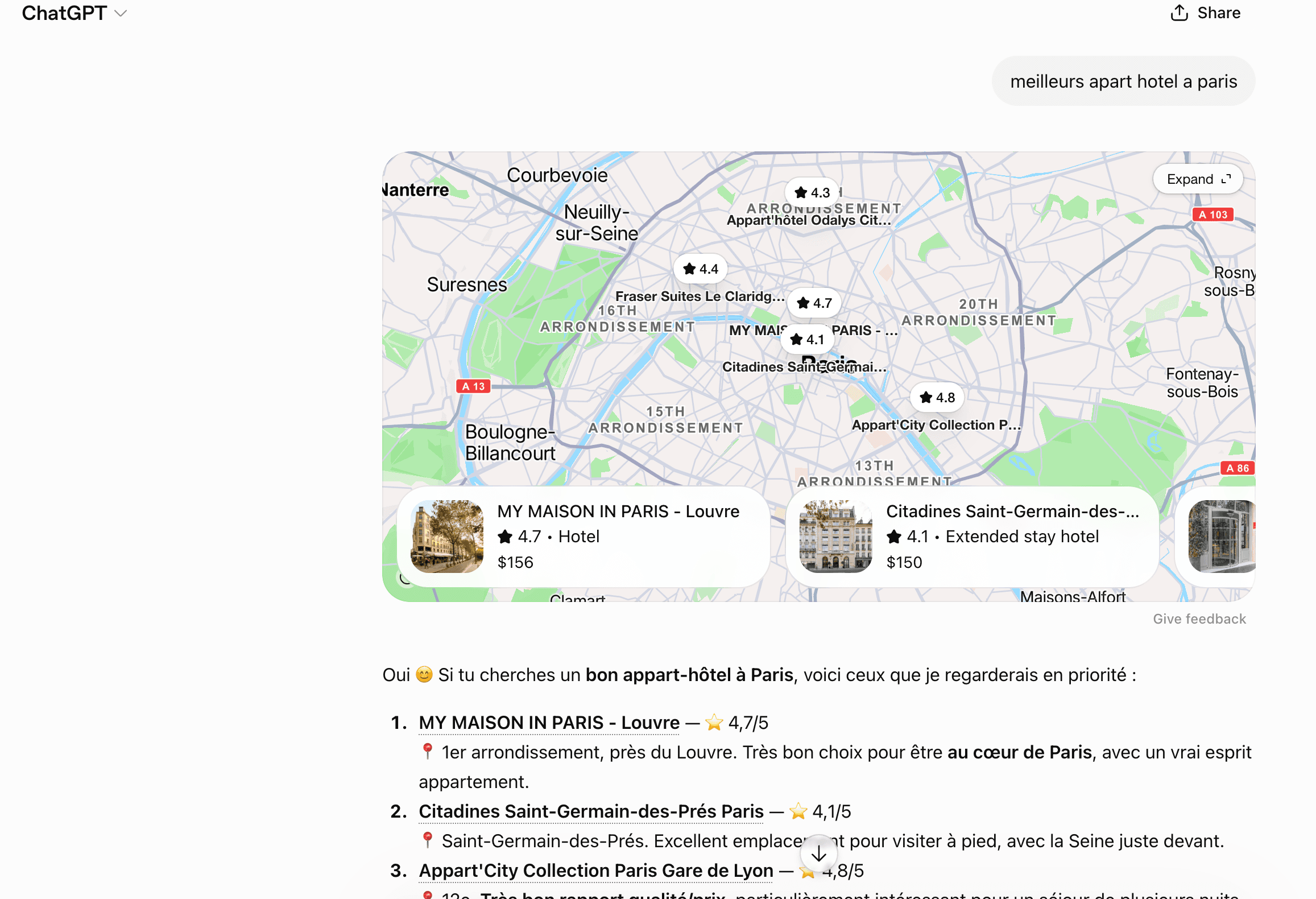
The screenshot that started this study: ChatGPT’s map widget tagging “MY MAISON IN PARIS - Louvre” as a Hotel and “Citadines Saint-Germain-des-Prés” as an Extended stay hotel, for the same query.
Summarize with AI


