ChatGPT hotel ads for logged-out users fell to almost zerothen partly came back
TL;DR: I send the same 616 hotel prompts to ChatGPT every week, logged out, from the US. In July, 84 to 90% of answers came back with an ad. In September it was 2 to 7%, and in the week of 5 October, 0.5%. In the week of 12 October it went back up to 14.1%, almost all of it Expedia. Ads on this surface have paused twice before. OpenAI has said nothing about logged-out users.
What I measure
The panel is 616 hotel prompts across 56 destinations: “best hotels in Chicago”, “hotels near Anne Frank House, Amsterdam”, “family friendly hotels in Zermatt” and so on. They are sent to ChatGPT once a week with web search on, logged out, from the US. The prompt list has been fixed since May. Before that the panel was smaller and less regular, so the March and April weeks are less comparable.
An answer counts as having an ad when it carries a sponsored unit. The chart below is the share of answers with one, week by week.
Week starting Monday. ChatGPT, logged out, scraped from the US. The week of 31 August could not be measured and is left empty. Hover a bar for the count.
From 90% to under 1% in two months
Ads peaked at 89.8% of answers in the week of 13 July and stayed between 83.2% and 89.8% for all of July. They eased to about 68% for three weeks in August. The week of 31 August could not be measured. From the week of 7 September the rate was 2.7%, then 6.8%, 3.7% and 2.3%. In the week of 5 October, 3 of 616 answers had an ad.
The provider I use to capture these answers told me it saw ads mostly disappear across its own traffic over the same period. So the drop is not limited to hotel prompts.
Logged-out ads have paused twice before
Ads first appeared in the week of 30 March, on about a third of answers. By the end of April they were down to 0.3%. They came back at 18.7% and 21.3% in mid-May, then disappeared for four weeks: 0.0%, 0.0%, 1.1% and 0.3% from 25 May to 15 June. On 22 June they returned at 44.5%, and two weeks later they were close to 90%.
In the week of 12 October, ads came back, mostly Expedia
The same prompts were captured three times on 12 and 13 October, for a separate study of the new questionnaire format. All three captures had more ads than any week in September, and the rate varied from one capture to the next.
| Capture (US, logged out) | Answers | With an ad |
|---|---|---|
| 12 Oct, 02:00 UTC | 616 | 61 (9.9%) |
| 12 Oct, 05:25 UTC | 616 | 157 (25.5%) |
| 13 Oct, 05:13 UTC | 616 | 43 (7.0%) |
Expedia placed 223 of the 261 ads. The rest were scattered: a coworking network 22 times, a Bahia Principe resort, The Mayfair Townhouse in London, an eSIM seller, a tour operator. Booking.com, the largest advertiser over the summer, has not appeared since the week of 14 September.
At 14.1% the October week is far from the summer level, and one week is not a trend. It does show that logged-out inventory has not been switched off.
Two travel agencies bought most of it
From 30 March to 5 October I recorded roughly 5,300 ads. Booking.com and Expedia account for about 7 in 10. Hotel groups bought placements too: Marriott and Preferred from the first weeks, IHG and Radisson over the summer.
| Advertiser | Answers with their ad | First seen | Last seen to 5 Oct |
|---|---|---|---|
| Booking.com | 1,961 | Mar 31 | Sep 14 |
| Expedia | 1,729 | Mar 31 | Oct 5 |
| IHG Hotels & Resorts | 154 | Jun 22 | Aug 24 |
| Airbnb | 153 | Apr 7 | Aug 17 |
| Radisson Hotels | 127 | Jul 13 | Aug 24 |
| Priceline | 99 | Mar 31 | Aug 24 |
| Preferred Hotels & Resorts | 89 | Mar 31 | Jun 22 |
| trivago | 72 | Apr 8 | Aug 24 |
| Luxury Escapes | 62 | May 17 | Sep 14 |
| Marriott | 60 | Mar 31 | Jul 6 |
| Hilton | 52 | Apr 13 | Aug 17 |
331 ads carried no readable advertiser name.
Meanwhile, the ad product moved towards identity
The product update emails OpenAI sends to ChatGPT advertisers describe a move from paying per click towards paying per impression, with sales credited to an ad that was only seen, and a growing set of ways to match an ad to a known person.
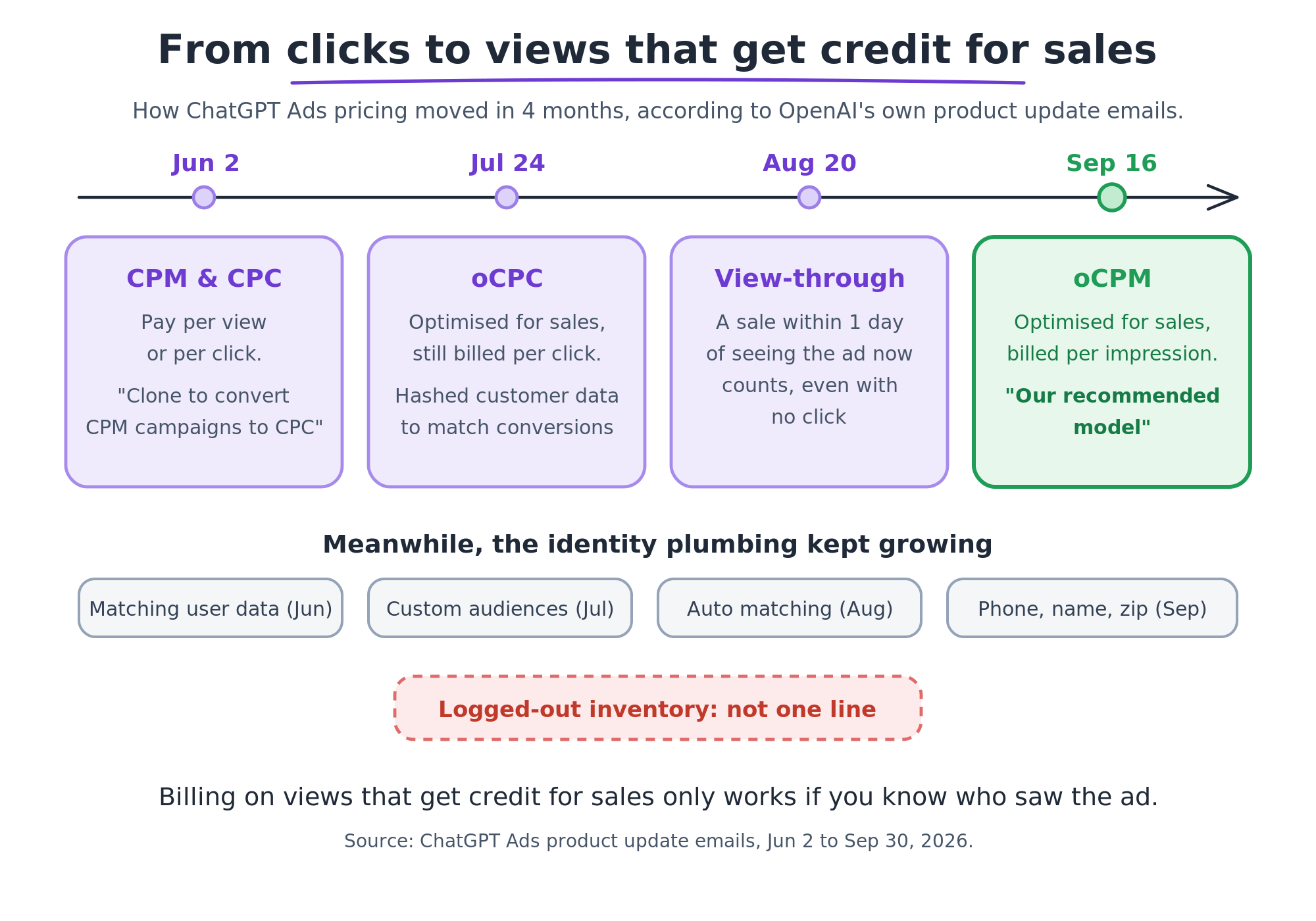
- 20 August: a sale within one day of seeing an ad can be credited to it, without a click.
- 3 September: more fields to match conversions (hashed email, phone, name, postal code) and larger custom audiences.
- 16 September: conversion optimisation billed on impressions becomes the recommended model.
None of these updates mentions logged-out users.
A logged-out impression is hard to price
Each of those features needs to know who saw the ad. This is my reading, not an OpenAI statement.
| An ad impression | Logged in | Logged out |
|---|---|---|
| Conversion matching | Hashed email and phone | Nothing to hash |
| Audiences | Custom audiences to include or exclude | No audience to match |
| View-through credit | A view can be credited with a booking | Hard to link the view to a sale |
| Frequency cap | Follows the person | Follows a browser at best |
| Consent and age | Known from the account | Must be safe for anyone |
If the product is moving to impressions priced on measured conversions, logged-out impressions are the ones that cannot be priced that way. The timing fits: the September drop came about two weeks after view-through credit and before impression billing became the recommended model.
It does not prove the link. I have no logged-in data to compare. Ads paused on this surface in April and June with no related announcement, and the October return shows the inventory is still sold. A test, or a throttle on logged-out inventory, fits the data as well as a deliberate exit.
What it means
- Advertisers: less logged-out inventory and better measurement on the logged-in part. Whether prices rise depends on how much of the volume was logged out, which I cannot see.
- OpenAI: fewer logged-out ads trade reach on people who never sign in for impressions it can measure and price. That is closer to how Meta sells ads than to search ads.
- Hotels: on logged-out ChatGPT, appearing in a hotel answer depends mainly on being recommended and cited. The paid slot next to it comes and goes, and when it is there, Expedia usually has it.
Methodology
- Prompts: 616 English hotel prompts across 56 destinations, fixed since May 2026. Before May the panel ranged from 81 to 1,099 prompts and some ran several times a week.
- Captures: ChatGPT answers scraped from the US, logged out, with web search on, once a week. The week of 12 October has three captures (12 October 02:00 and 05:25 UTC, 13 October 05:13 UTC).
- Ad detection: until 24 August, from the sponsored unit in the answer stream. From 7 September, from the list of ads returned with each capture, because the stream stopped arriving on most captures. The two methods are not directly comparable, which is why the chart colours them differently.
- Advertiser: the name on the ad, or the advertiser’s domain when no name was given.
Limits
- Logged-out ChatGPT only. Logged-in users may see a different rate.
- Hotel and travel prompts only, in English, from the US.
- The week of 31 August has no measurement, so the exact date of the drop is approximate.
- The ad-product dates come from OpenAI’s emails to advertisers, not from a public announcement.
- Summary data: summary.csv.
FAQ
Summarize with AI


