ChatGPT hotel answers now end with a questionnaireand the map moved down
TL;DR: Between 7 and 12 October 2026, ChatGPT started writing hotel answers as interactive components. Across 1,848 answers to the same 616 hotel prompts, 59% now end with a short questionnaire that asks for a budget, dates and who is travelling, with options already selected by the model. The button sends the choices back as a chat message; it does not check availability. The map moved from the top of the answer to the end.
What the new answer looks like
The query was “best family hotels in Sanur”, typed with a typo, on a logged-in free ChatGPT account in the EU. The answer opened with six hotels, each with a photo, a “best for” badge, two source chips and a price category from $ to $$$$. It then gave a short verdict (“Which would I choose?”), then the map, then a section titled “Let me narrow it down for your family”.
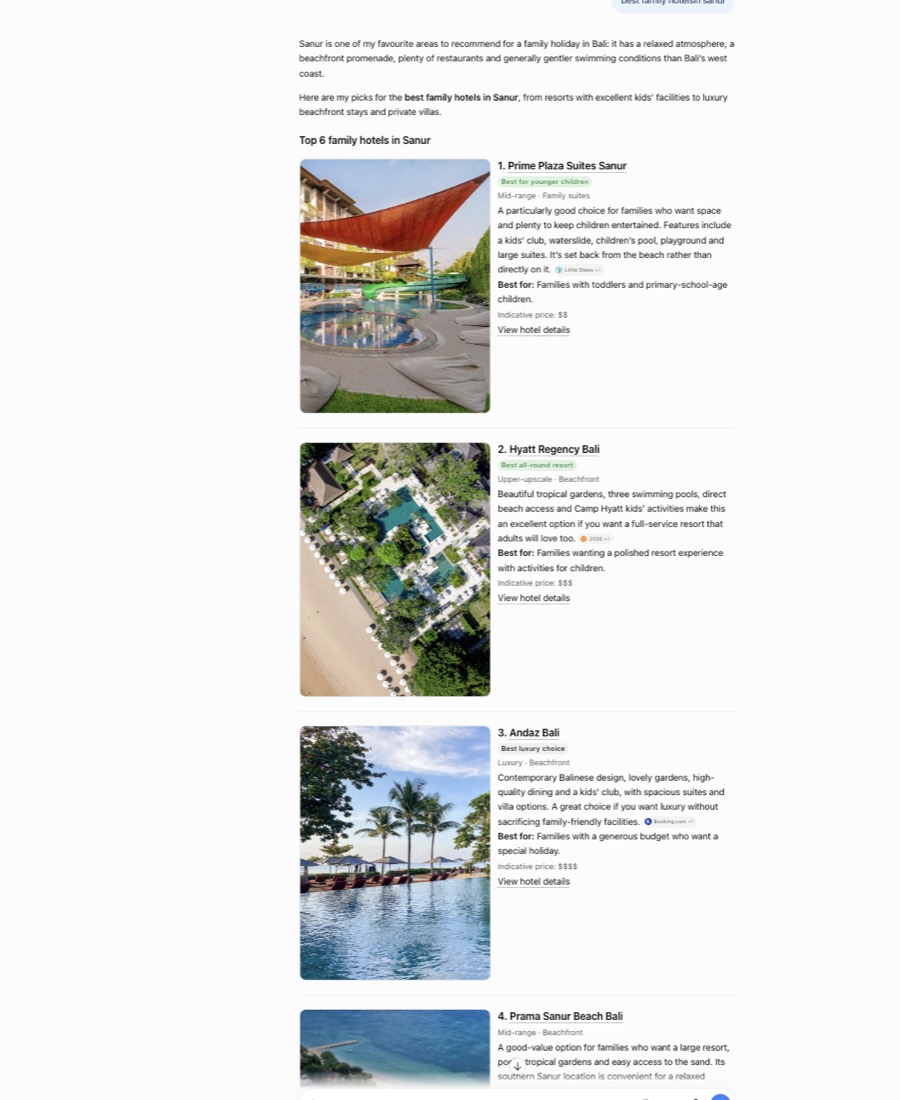
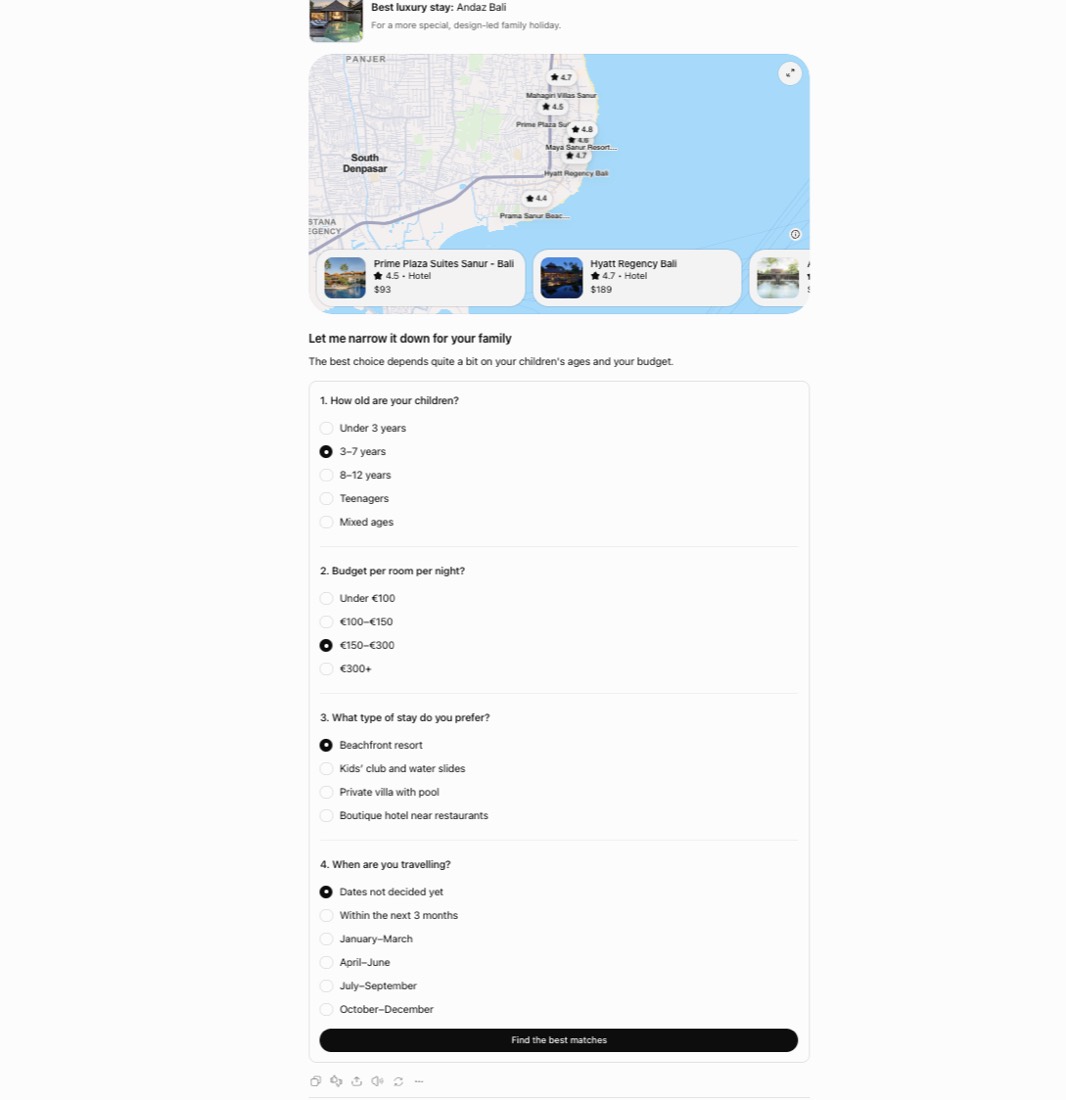
The questionnaire had four questions: children’s ages, budget per room per night, type of stay and travel dates. One option was already selected in each: 3–7 years, €150–€300, beachfront resort, dates not decided yet. A black button reading “Find the best matches” closed the form. To see how common this is, I looked at the hotel answers I capture every week.
The switch landed between 7 and 12 October
I send the same 616 hotel prompts to ChatGPT from the US, logged out, on a schedule. On 5 October, none of the 616 answers contained a single interactive component. On 12 October, every answer did. Smaller runs on 6 and 7 October still show the old format.
The new answers carry component markers in their HTML (data-d-component="radio-group", "date-picker", "badge", "button"). The old ones carry none. I counted a questionnaire when an answer contained a radio group, a date picker, a text input or a select field.
| Capture (US, logged out) | Answers | New format | With questionnaire |
|---|---|---|---|
| 5 Oct, 02:00 UTC | 616 | 0 | 0 |
| 12 Oct, 02:00 UTC | 616 | 616 | 367 (60%) |
| 12 Oct, 05:25 UTC | 616 | 609 | 374 (61%) |
| 13 Oct, 03:00 UTC | 616 | 613 | 353 (57%) |
The change is not limited to logged-in users or to Europe. The same structure appears in logged-out answers from the US and in a logged-in free account in the EU.
Traveller-type queries get it most often
The form does not appear on every hotel query. It depends mostly on the type of prompt. Queries that name a type of traveller get one most often. Queries about a specific feature or place get one least often.
Three runs of the same 616 US prompts, 12–13 October 2026. Whiskers are 95% intervals. Hover a bar for n.
The same prompt does not always get the same treatment. Over the three runs, 203 prompts got a questionnaire every time, 169 got one twice, 147 once and 97 never.
Budget always, dates usually
Budget is the one constant: 1,093 of the 1,094 forms ask for it. The currency follows the destination, so a Singapore query asks in S$, Dublin in euros and the Gold Coast in AUD. Dates come next. The other questions vary with the prompt: who is travelling, the style of hotel, the area, the occasion, or “what matters most”.
Share of the 1,094 questionnaires that include each field. Classified by keyword on the question text, so the shares are approximate. Date pickers are counted from the component itself.
145 questionnaires go further and include date pickers for check-in and check-out. They appear mostly on price-led queries (“affordable hotels in San Francisco under $200”) and on “hotels near [landmark]” queries. The San Francisco form read:
What dates are you planning to stay in San Francisco?
Check-in   [Choose arrival date]
Check-out  [Choose departure date]
Guests     ( ) 1 adult  (•) 2 adults  ( ) 2 adults and children
Preferred location ...
Budget preference  (•) Under $200 before taxes
                   ( ) Under $200 total per night, including taxes and fees
[ Find hotels for my dates ]The pre-selected answers are the model’s guess
All 1,094 questionnaires in the US sample arrived with options selected. The raw response of the Sanur answer shows where they come from. The model writes the whole answer as component code, including the state of the form:
const [ages,   setAges]   = DIL.useState("3–7 years")
const [budget, setBudget] = DIL.useState("€150–€300")
const [style,  setStyle]  = DIL.useState("Beachfront resort")
const [when,   setWhen]   = DIL.useState("Flexible")
The user had given none of this. The model assumed a family with young children, a mid-range budget and a beach preference, and pre-filled the form accordingly. A user who clicks the button without changing anything sends those assumptions as their own.
What the button does
<button onClick={() => GenUI.issueNewTurn(
  "Recommend the best family hotels in Sanur, Bali. Children's ages: " + ages +
  ". Budget per room per night: " + budget +
  ". Preferred accommodation: " + style +
  ". Travel timing: " + when +
  ". Compare the best matches and explain the trade-offs.")}>
  Find the best matches
</button>
The button writes a sentence from the four answers and sends it as the next message. It does not call an availability or pricing service and does not pass structured filters to a booking partner. For now, the form collects search criteria and turns them back into a chat prompt.
The map moved from the top to the end
On 5 October, the map sat at the start of the answer, before the hotel list: 99.5% of the maps were in the first tenth of the answer. From 12 October, it sits after the list and the verdict, just before the questionnaire. The median position of the map moved from 2% of the way into the answer to 77%.
Old format. 549 answers with a map. Position is the share of the answer text that comes before the map.
New format. 1,306 answers with a map, three runs.
The map is also shown less often: on 93% of answers on 5 October (574 of 616) and on 71% after the change (1,306 of 1,848). In the Sanur answer, the position is set by the model, which places the <MapWidgetV2> component where it chooses in the markup it writes.
The hotel card is a Google listing
In the Sanur answer, each hotel is a Google place record. The entity IDs are Google Maps place IDs (ChIJ…) with provider: "serp", and they carry the rating, review count, phone number, price and website as they appear on Google.
Two of the six website links kept Google’s tracking parameters (utm_source=google&utm_medium=organic), so a click from ChatGPT on those cards would be reported as Google organic traffic. The photos come from a separate image search written by the model: 1 of the 9 images in the answer came from the hotel’s own website.
This section rests on a single answer.
Ads sit next to the questionnaire
The US captures also carry ChatGPT’s ad units. Across the three runs, 261 of the 1,848 answers (14%) showed an ad. Answers with a questionnaire carried ads at the same rate as answers without one (14.4% and 13.7%).
| Advertiser | Ads |
|---|---|
| Expedia | 223 |
| Workgrounds, Inc. | 22 |
| PageOne Lab, Inc. | 3 |
| Viator | 2 |
| Kensington Tours | 2 |
| Original Resorts & Cruises | 1 |
| OfficeRnD | 1 |
| Beechwood Homes | 1 |
| AirGSM Pte. LTD. (Airalo) | 1 |
| Luxury Escapes | 1 |
| Airbnb | 1 |
| Bahia Principe | 1 |
| London & Regional (Green Park Hotel) Ltd | 1 |
| Flagship Amsterdam | 1 |
Expedia placed 223 of the 261 ads. Its ads either promote a destination (“Hotels in Vienna, Austria”, 93 ads) or one named hotel (“Yotel Miami”, 130 ads). Of the hotel-specific ones, about 26 promoted a hotel that the answer also recommended. The other 104 promoted a hotel the answer did not mention.
Two hotels bought ads directly: The Mayfair Townhouse in London (the advertiser is London & Regional) and a Bahia Principe resort. Some ads had nothing to do with hotels, such as a coworking network shown 22 times. In the EU Sanur session, the only ad was an eSIM for Indonesia.
What it means for hotels
- The questionnaire is a filter. After the first list, the next answer is narrowed by budget, dates, party and style. A hotel that is not clearly described for a segment (young children, teenagers, couples, a villa with a pool) has less chance of surviving that step.
- The default answers matter. The model pre-selects a budget band and a style before the user does anything. Hotels that fit the assumed profile start ahead.
- The search fields are already collected. Dates, guests and budget are the inputs of an availability request. The button sends them as text today. Connecting it to live rates would be a small step.
- The Google Business Profile is the hotel card. Rating, reviews, phone, price and website link are copied from it. A tracked website link on that profile reports ChatGPT clicks as Google organic.
- The map now comes after the list. The ranked list at the top carries the decision, and a hotel no longer gets visibility from the map before the list.
Methodology
- Prompts: 616 English hotel prompts (best, luxury, boutique, family, couples, solo, business and budget hotels, hotels near landmarks and hotels with specific amenities) across cities worldwide.
- Captures: ChatGPT answers scraped from the US, logged out, on 5 October (02:00 UTC), 12 October (02:00 and 05:25 UTC) and 13 October 2026 (03:00 UTC). The same prompts every time.
- Questionnaire detection: from component markers in the rendered HTML (radio group, date picker, text input, select), not from the wording of the answer.
- Map position: the share of the answer’s text that comes before the map element.
- Fields: classified by keyword on the questionnaire text. Approximate.
- Raw response: the Sanur example is a single logged-in free-plan session in the EU on 13 October 2026, read from its full response stream.
- Intervals: Wilson 95%.
Limits
- The questionnaire may be an experiment shown to part of users, and the rate may change from week to week.
- The US data is logged out and in English. Logged-in answers were seen once, in the EU.
- The defaults, the button code and the Google place records come from one raw response.
- Summary data: summary.csv.
FAQ
Summarize with AI


More on ChatGPT and hotels
Disclosure: I work at Lighthouse, which owns The Hotels Network.