How ChatGPT pulls hotel prices:it scrapes the OTAs, then cites Reddit
TL;DR: Ask ChatGPT what a hotel costs and it goes to the live web 98.8% of the time. It fetches online travel agencies (Booking, Expedia, Kayak) more than every other source combined — but cites them least (11%). It reads the price off those pages, then footnotes someone more readable: Reddit gets cited 100% of the time it's fetched. And the price you see almost always rides one licensed retrieval tier (labrador), not the scraper tier.
Executive Summary
ChatGPT treats online travel agencies as price oracles to read from — not as the sources it shows you.
We asked ChatGPT 30 hotel-price questions — 12 named hotels across four segments and three cities, plus open “cheapest hotel” queries — and ran each eight times through Bright Data. For every answer we parsed ChatGPT's raw response stream down to its network-source layer: each document it fetched, the retrieval tier that served it (result_source), and whether it was actually cited. That's 240 captures and 3,092 fetched documents.
The plumbing is consistent and a little surprising. A price question almost always hits the live web. ChatGPT casts a wide net over the OTAs to read the number, then cites a much smaller, more human-readable set — forums and editorial win the footnote, official sites win for chains and luxury, and the cited price rides the licensed labrador tier rather than the Bright Data scraper tier the trade press associates with shopping.
A price question always reaches the web
Before searching, ChatGPT files each query into a bucket (turn_use_case) that decides whether the web is touched. For generic hotel questions a large share land in text — answered from memory, no retrieval. Attach a price and that disappears: every price prompt routed to a live-search bucket.
| turn_use_case | Share of price turns | Hits the web? |
|---|---|---|
| instant search | 85% | Yes |
| local | 15% | Yes (maps / places) |
| text | 0% | No — none landed here |
It fetches the OTAs the most and cites them the least
Here is every document ChatGPT fetched for a price question, grouped by source class, against how often a fetched document of that class was actually cited. The gap between the two is the whole story.
| Source class | Fetched | Cited | Cite rate |
|---|---|---|---|
| Forum / social (Reddit) | 51 | 51 | 100% |
| Editorial | 29 | 17 | 59% |
| Deal / loyalty / points | 170 | 54 | 32% |
| Metasearch (Kayak, Trivago, Google) | 477 | 89 | 19% |
| Official hotel site | 554 | 87 | 16% |
| OTA (Booking, Expedia, Klook) | 1,434 | 154 | 11% |
Reddit gets cited every single time
The flip side of the OTA gap: when ChatGPT pulls a forum thread or a magazine piece about what a hotel really costs, it almost always surfaces it. These are the most-cited individual price domains.
| Domain | Class | Times cited |
|---|---|---|
| booking.com | OTA | 64 |
| reddit.com | Forum / social | 51 |
| kayak.com | Metasearch | 37 |
| expedia.com | OTA | 36 |
| hilton.com | Official | 32 |
| klook.com | OTA | 20 |
| saverrooms.co.uk | Deal / loyalty | 14 |
| google.com | Metasearch | 11 |
The cited price rides the licensed tier, not the scraper
ChatGPT stamps each fetched page with result_source — the pipeline that served it. The trade press associates the bright (Bright Data) tier with shopping and finance. For hotels it does show up in the fetch layer — but it nearly vanishes from what gets cited.
| Retrieval tier | Fetched | Cited |
|---|---|---|
| labrador (licensed / quality-gated) | 2,447 | 392 |
| bright (Bright Data datasets) | 170 | 3 |
| serp (open-web baseline) | 4 | 0 |
| untagged (footnote-only) | 471 | 76 |
bright appears in the fetch layer (170 documents) but is cited just 3 times. Every cited price source we can tier resolves to labrador. So the “Bright Data dominates shopping” story holds for what ChatGPT fetches — but for hotels, the price you read came through the licensed tier. (The untagged-but-cited rows are Reddit and editorial, which arrive via a separate footnote path and carry no tier.)Where the price comes from depends on the hotel
“Where does the price come from” has no single answer — it tracks how much of a hotel's inventory the OTAs control. Cited source-class share, by hotel segment:
| Segment | OTA | Official | Deal / loyalty | Metasearch | Forum |
|---|---|---|---|---|---|
| Palace (Ritz, Savoy, Plaza) | 21% | 30% | 23% | 11% | 7% |
| Global chain (Hilton) | 32% | 31% | 10% | 12% | 15% |
| Boutique indie | 37% | 15% | 10% | 19% | 10% |
| Budget chain (ibis, Premier Inn, Pod) | 30% | 17% | 15% | 27% | 11% |
| City-level open queries | 44% | ~0% | — | 25% | 12% |
brand.com holds its own. But boutique independents get OTA-priced 37% of the time versus their own site only 15%, even when they run a strong direct-booking site. Open “cheapest hotel” questions lean hardest on aggregators of all.What it actually quoted — and which numbers to distrust
The per-night figure ChatGPT typically quoted for each named hotel (median across 16 captures), next to the source it leaned on. The source is a tell: when it's the official site, the number tends to hold; when it's a deal blog or an unrelated chain, distrust it.
| Hotel | Segment | Typical / night | Dominant cited source |
|---|---|---|---|
| Hilton Times Square | Global chain | ~$235 | hilton.com (official) |
| The Plaza | Palace | $1,250–$1,900 | theplazany.com (official) |
| Hilton Paris Opéra | Global chain | €260–€350 | hilton.com + Kayak |
| The Savoy | Palace | £1,000–£1,900 | Booking.com |
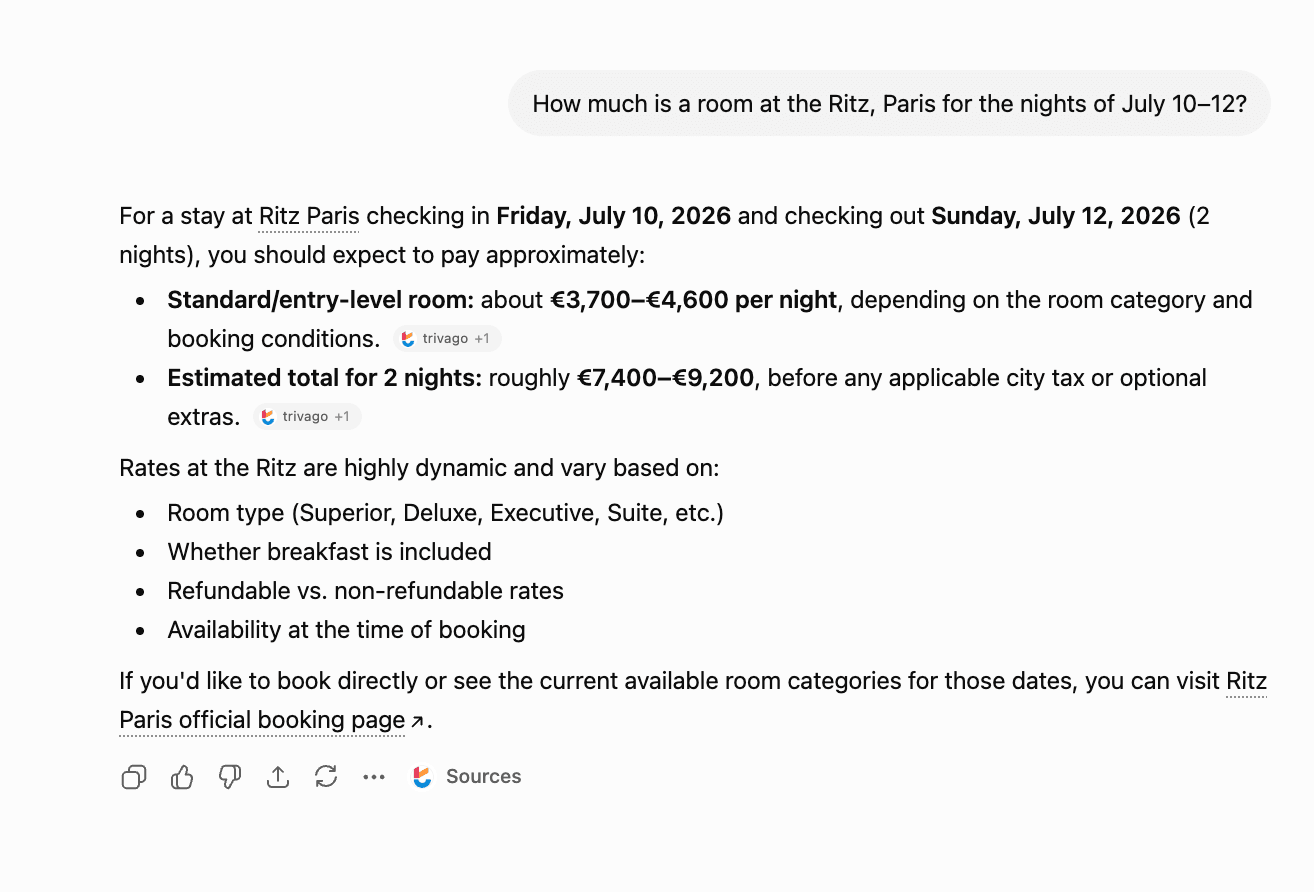
| Ritz Paris | Palace | ~$2,900 | Travelzoo, Amex FHR, points blogs |
| The Greenwich Hotel | Boutique indie | $1,200–$1,800 | Kayak + official |
| Hilton London Park Lane | Global chain | £250–£500 | Booking.com + hilton.com |
| Grand Hôtel du Palais Royal | Boutique indie | ~$800–$850 | Expedia / Booking ⚠ |
| Hazlitt’s | Boutique indie | £450–£600 | hotelpricewatch, Expedia, deal blogs |
| ibis Paris Tour Eiffel | Budget chain | €160–€170 | Klook (unusual channel) |
| Pod 51 | Budget chain | $105–$130 | Booking, Google, Kayak |
| Premier Inn County Hall | Budget chain | £100–£260 | saverrooms.co.uk (deal blog) ⚠ |
saverrooms.co.uk, a third-party deal blog — not premierinn.com, which publishes hard, JavaScript-light rates of its own; the £100–£260 spread is suspiciously wide. (2) ibis Paris was priced off Klook, a Southeast-Asia-centric OTA, over Accor's own site. (3) Grand Hôtel du Palais Royal, an independent, cited hilton.com — a wrong-entity citation, so its ~$800 may be anchored to an unrelated property. By contrast the official-sourced figures (Hilton Times Square, The Plaza) should track reality closely.Gemini doesn't scrape — it reads Google Hotels
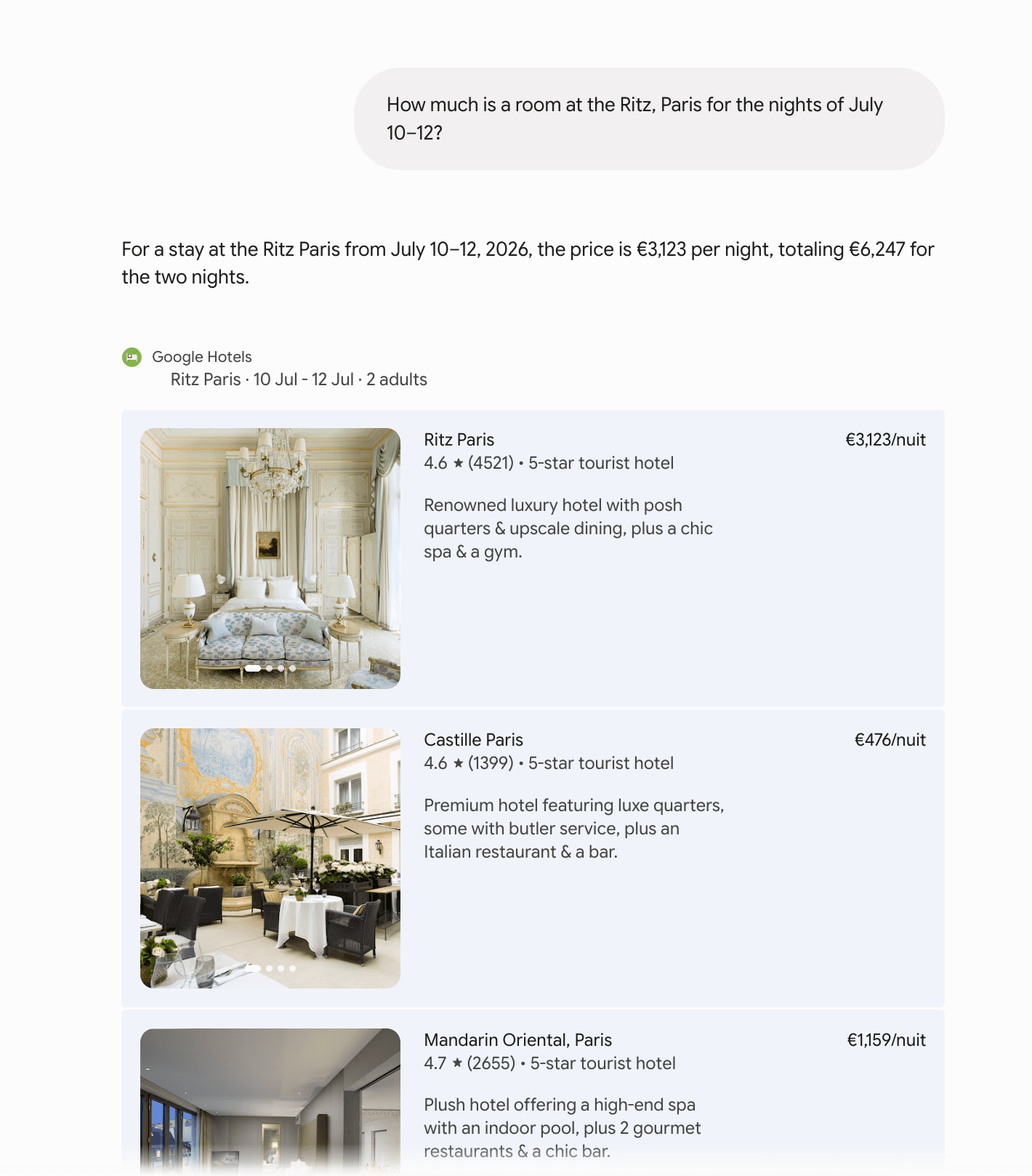
Everything above is about ChatGPT, which has no hotel inventory of its own and so reconstructs a price by fetching the open web — OTAs, deal blogs, Reddit — and quoting whatever it can read. Gemini sits in a different position entirely. Ask it the exact same question and it answers from Google Hotels: Google's own structured travel feed, with live rates and a property panel rendered inline.
That changes where the number comes from. The €3,123/night it quotes for the Ritz is not scraped off an OTA page and footnoted to an editorial source — it is read straight from the same licensed hotel-rate inventory that powers the Google Hotels widget, alongside ranked alternatives (Castille, Mandarin Oriental) drawn from the same feed. Provenance is Google's, not the open web's.
The practical takeaway for hoteliers is that the two engines reward different things. ChatGPT's price is only as good as the pages it can read about you, so OTA presence and a crawlable rate page matter. Gemini's price rides on your Google Hotel Center / Google Business Profile feed — get that right and the number is yours, not an aggregator's guess. This is a single illustrative capture, not part of the 240-capture ChatGPT dataset — a contrast worth flagging, and a study of its own.
But what was the real price at the time?
This study set out to measure where a price comes from, not whether it's right — partly because “the real price” is slippery (rates move hourly, by room type, by fees). But the Gemini capture above hands us a rare ground-truth anchor: Google Hotels quotes a live, bookable rate. For the one hotel that appears in both, the Ritz Paris, on the exact same nights, the gap is the whole point.
Read those three boxes together and the failure mode is clear. ChatGPT is not querying live availability; it is reconstructing a plausible number from cached OTA pages, deal blogs and peak-season editorial, then hedging with a wide band. That is why its quote for the same hotel and the same dates lands ~20–50% high in one capture and at a different value — in a different currency — when averaged across runs. Google Hotels asks the inventory what a room actually costs. One is a memory of prices; the other is a price.
Study Design
Data Collection
- 30 frozen price prompts: 12 named hotels (4 segments × 3 cities) plus open city-level questions, each run 8× via Bright Data, country US, 25 Jun 2026 — 240 captures.
- Each capture parsed from the raw SSE stream into its network-source layer: every fetched document with
result_sourcetier and cited flag — 3,092 documents, 471 cited. - Prices extracted from the prose answer per capture; source classes curated from observed domains.
Caveats
- N = 240, one capture day, US proxy, English only — a snapshot, not a trend.
- Cited documents arrive via a footnote path with different URL strings than the tier-tagged fetches, so a cited source's tier is imputed from its domain's modal tier. All raw rows are stored.
- The structured shopping block never fired for hotels (it is a products surface); prices come via the map panel and prose.
oxylabsdid not appear in this hotel run;serpappeared 4× and was never cited.
The 30 frozen prompts
Every prompt carries the same concrete, live-bookable dates (July 10–12, ~2 weeks out from the run) and was sent logged-out from a US IP, 8× each. The set is the four templates below crossed with the 12-hotel panel and 3 cities — 24 named + 6 open = 30.
price_pointHow much is a room at [hotel] for the nights of July 10–12?
cheapestWhat’s the cheapest way to book [hotel] for July 10–12?
budget_listWhat are the best hotels in [city] under [budget] a night for July 10–12?
cheapestWhere can I find the cheapest hotel in [city] for July 10–12?
[hotel] draws from the 4 segments × 3 cities panel; [city] is Paris, London or New York; [budget] is €250 / £250 / $250 respectively.
| Segment | Paris | London | New York |
|---|---|---|---|
| Palace | Ritz Paris | The Savoy | The Plaza |
| Global chain | Hilton Paris Opéra | Hilton London Park Lane | Hilton Times Square |
| Boutique / indie | Grand Hôtel du Palais Royal | Hazlitt’s | The Greenwich Hotel |
| Budget chain | ibis Paris Tour Eiffel Cambronne 15ème | Premier Inn London County Hall | Pod 51 Hotel |
Open data. Headline stats and the underlying tables are published as CSV: summary.csv, fetch_vs_cite.csv, tier_distribution.csv, by_segment.csv, top_cited_domains.csv, quoted_prices.csv.
Summarize with AI


