AI Search for Specialty Coffee in Marseille (2026):When Instagram and local blogs beat café websites
TL;DR: Marseille is the first non-Tokyo case in this series where ChatGPT mostly ignores the businesses’ own websites. Only 10% of its citations go to café websites, versus the ~32% we measured in Paris yoga, Berlin yoga and Amsterdam bikes (Tokyo bookstores was already an exception, at 8%). Instead it pulls from Reddit, list & review aggregators, French micro-guides and, unusually, Instagram — which returns 237 cites across 3 of the 5 engines, the highest social signal in any of our studies. By the “does the engine actually name the brand” metric, Deep is the consensus winner — named in 59.3% of ChatGPT captures and across all five engines. The lesson: in Marseille, AI search mirrors the city’s real discovery layer — and that layer isn’t websites. It’s Instagram, local guides and social proof.
Executive Summary
Marseille is the second city in this series where the entity-engine pattern breaks — and the first in a Western market. Marseille coffee runs on third-party sources, not café websites.
By “entity-engine,” I mean the pattern from prior studies where ChatGPT often grounds a local recommendation in the business’s own website, not only in third-party guides. Across Paris yoga, Berlin yoga and Amsterdam bikes, it cited the entity’s own site around a third of the time — what we’d been treating as a consistent baseline. Tokyo bookstores already broke it, at 8%. For Marseille coffee the figure is 10%. The missing citations don’t go to a single source — they go to a trio: 31% social — Reddit leads that bucket — 32% list & review aggregators (Wanderlog, Mapstr), 14% French micro-guides (marseille.love-spots.com, marseillesecrete.com, tarpin-bien.com, lescachotteriesdemarseille.com). That’s 77% of ChatGPT’s Marseille answers grounded in third-party content.
The likely mechanism is the same one Berlin hinted at: the source mix bends toward a city’s local commercial and editorial infrastructure. Marseille just has an unusual one — a small specialty-coffee scene with a thin owned-web footprint (only 114 of 280 venues have a website at all), a heavy Instagram-native discovery layer (237 cites, our highest social signal anywhere), and a dense thicket of French micro-guides. AI engines mirror what’s out there; where the documentation lives, the citations follow.
And there’s a structural reason the owned web is so thin here: a café has no online transaction. A yoga studio sells class bookings on its site; a hotel sells rooms. That gives the website a job — so it gets built, linked and crawled. A coffee shop sells nothing online, so the website is optional, and the scene documents itself where people actually look: Instagram, Reddit and local guides. The AI source mix just follows that.
One distinction throughout: citations are the URLs an engine used as support; mentions are the cafés actually named in the visible answer. The source-mix numbers are about citations (where AI search is grounded); the leaderboard later is about mentions (who users actually see). They don’t always agree — which is the point.
Source mix by platform
For every cited URL we bucketed the source into one of ten categories. The mix per engine is the cleanest way to see why Marseille breaks the pattern — especially compared to the consistent shop/studio-website share we measured in three earlier cities.
Still entity-engine — but at 83%
The 95–97% Copilot range we measured in yoga and bikes drops to 83% in Marseille. Even the engine that goes hardest on shop websites loses 12 points here. The weak digital footprint of Marseille coffee — most venues without a website — likely pushes Copilot into the long tail it usually ignores.
Swings to global trade press: 34%
Gemini seems to look for an authoritative editorial layer; when the local specialty-coffee layer is thin, that slot gets filled by global trade press. baristamagazine.com alone returned 95 citations — more than any shop website on Gemini, and roughly 34% of Gemini’s Marseille citations.
Leads with local editorial: 27%
Perplexity leans on the French local-guide ecosystem more than any other engine — 27% of its Marseille citations go to marseille.love-spots.com, marseillesecrete.com, tarpin-bien.com and similar French micro-guides. Where Marseille is documented in French, Perplexity finds it.
The ChatGPT inversion
One number tells the whole story of this article. ChatGPT’s shop-website citation share for Marseille specialty coffee is the lowest we’ve measured in five cross-vertical replications — and the gap to the other “city + scene” cases is what makes it interesting.
| City + vertical | ChatGPT shop-site % | Signature non-shop source |
|---|---|---|
| Paris yoga | 32% | Reddit (16% of all ChatGPT URLs) |
| Berlin yoga | 32% | Urban Sports Club blog |
| Amsterdam bikes | 42% | |
| Tokyo bookstores | 8% | whenin.tokyo + Tokyo Weekender |
| Marseille coffee | 10% | Reddit + Instagram + FR local blogs |
The Instagram signal
One domain stands out so far above the rest of the social layer that it deserves its own section.
No other city/vertical pushes Instagram this hard.
In Paris yoga, Berlin yoga, Amsterdam bikes and Tokyo bookstores, the dominant social signal was Reddit — Instagram barely registered (single digits to low double digits at most). For Marseille specialty coffee, Instagram joins Reddit as a co-equal source: Reddit at 175 cites, Instagram at 237.
In the dataset, Marseille coffee behaves like an Instagram-native scene — and it isn’t a single-engine artifact: Instagram appears across 3 of the 5 engines. Many specialty shops here document themselves there in preference to a website —Nua is the cleanest example: no website, only an Instagram account, and ChatGPT’s answers cite that Instagram URL as the primary source. AI engines reflect this by surfacing Instagram URLs as primary citations rather than social-proof addenda. If you’re ranking a Marseille café for AI visibility, “own your Instagram” may be closer to the AI-search truth than the generic “own your website” playbook.
The Marseille Specialty Coffee AI Leaderboard
Aggregating shop mentions across the engines (chain locations merged), these are the most-cited Marseille cafés. “Engines” is the number of the five AI engines that surfaced the shop at all — a breadth signal.
| Rank | Shop | Text mentions | Cite score | Engines |
|---|---|---|---|---|
| #1 | Deep | 200 | 131 | 5 / 5 |
| #2 | 7VB Café | 141 | 66 | 5 / 5 |
| #3 | Black Bird Coffee | 122 | 42 | 5 / 5 |
| #4 | Café Lauca | 114 | 101 | 5 / 5 |
| #5 | Boujou Coffee | 103 | 54 | 5 / 5 |
| #6 | Ben Mouture | 100 | 30 | 5 / 5 |
The same leaderboard, split by engine
Reading across a row: the share of each engine’s prompt-captures whose visible answer text names the brand (raw count in parentheses). Because each engine answered a different number of prompts (ChatGPT 91, Gemini / Copilot / Perplexity 92, AI Mode 46 — AI Mode × FR failed at the capture tool’s trigger), raw counts aren’t comparable across columns, so we render them as rates.
Deep (the café at deep.coffee) dominates the heatmap: named in 59.3% of ChatGPT’s captures, 46.7% of Gemini, 48.9% of Copilot, 45.7% of Perplexity and 34.8% of AI Mode — a universal recommendation. 7VB Café and Boujou Coffee are similarly broad. Black Bird Coffee (#3) and Ben Mouture (#6) land high despite being absent from the original Google Maps seed — the engines named them often enough that we recovered and verified them via Google Places (see methodology). Their presence is the reminder that AI search surfaces specialty shops a Maps scrape can miss.
| # | Shop | AI Mode46 prompts | ChatGPT91 prompts | Perplexity92 prompts | Gemini92 prompts | Copilot92 prompts |
|---|---|---|---|---|---|---|
| 1 | Deep | 34.8%(16) | 59.3%(54) | 45.7%(42) | 46.7%(43) | 48.9%(45) |
| 2 | 7VB Café | 39.1%(18) | 33%(30) | 27.2%(25) | 41.3%(38) | 32.6%(30) |
| 3 | Black Bird Coffee | 39.1%(18) | 42.9%(39) | 18.5%(17) | 8.7%(8) | 43.5%(40) |
| 4 | Café Lauca | 30.4%(14) | 46.2%(42) | 12%(11) | 4.3%(4) | 46.7%(43) |
| 5 | Boujou Coffee | 39.1%(18) | 40.7%(37) | 15.2%(14) | 14.1%(13) | 22.8%(21) |
| 6 | Ben Mouture | 28.3%(13) | 39.6%(36) | 5.4%(5) | 26.1%(24) | 23.9%(22) |
| 7 | Coffee&Bakery | 37%(17) | 33%(30) | 12%(11) | 0(0) | 31.5%(29) |
| 8 | La Brûlerie MÖKA | 17.4%(8) | 19.8%(18) | 18.5%(17) | 35.9%(33) | 8.7%(8) |
| 9 | Risette | 37%(17) | 40.7%(37) | 5.4%(5) | 3.3%(3) | 21.7%(20) |
| 10 | Coogee | 13%(6) | 8.8%(8) | 19.6%(18) | 33.7%(31) | 13%(12) |
| 11 | Petrin Couchette | 13%(6) | 15.4%(14) | 1.1%(1) | 35.9%(33) | 0(0) |
| 12 | Tarlata Café | 4.3%(2) | 9.9%(9) | 19.6%(18) | 1.1%(1) | 10.9%(10) |
Cell = % of that engine’s captures in which the brand was named in the visible answer text; raw count in parentheses. Rows ordered by total text mentions (matching the leaderboard above). Colour scales with the table maximum (Deep on ChatGPT). Zeros greyed. Hover a cell for the underlying counts.
Where the winners are
The 12 leaderboard brands plotted on the map — chains show all their locations (Café Lauca, Boujou and La Brûlerie MÖKA have two each). Click a marker for the per-engine text-mention breakdown.
Top 12 most-cited brands — locations, popups show per-engine text mentions
Top cited sources, cross-platform
Every domain cited by at least 3 of 5 platforms with 30+ cites. Read this as the working infrastructure of AI search for Marseille specialty coffee.
| Platforms | Cites | Bucket | Domain |
|---|---|---|---|
| 4 / 5 | 175 | social | reddit.com |
| 4 / 5 | 93 | editorial — local | marseille.love-spots.com |
| 4 / 5 | 76 | review aggregator | wanderlog.com |
| 4 / 5 | 54 | entity website | cafelauca.com |
| 4 / 5 | 36 | editorial — local | marseillesecrete.com |
| 3 / 5 | 237 | social | instagram.com |
instagram.com at 237 cites is the row to notice. It shows up on 3 of 5 platforms with the highest single-domain count outside AI Mode’s Google self-citations — and no prior city or vertical in this series has surfaced Instagram even close to that volume. Reddit (175 cites, 4 platforms) is the more “expected” social signal; Instagram is the Marseille-specific one.
EN vs FR — the sharpest split we’ve seen
Same intent, different language, different shops. For Marseille the divergence is the largest in the cross-vertical series so far.
| Template | EN vs FR top-5 overlap |
|---|---|
| dist_cours_julien | 67% |
| price_cheap | 43% |
| dist_panier | 43% |
| brew_pourover | 25% |
| brew_espresso | 25% |
| brew_coldbrew | 25% |
The control prompt overlaps just 11% — only 1 of the top 5 shops matches between English and French. For comparison, Berlin’s control was 25% and Paris yoga’s was 25%. Marseille is roughly half as language-stable as the previous two non-anglophone replications.
The cause is structural and follows directly from the source mix: with so little global specialty-coffee press covering Marseille, English prompts pull from a small English-language source set (Reddit threads, Wanderlog, Barista Magazine) while French prompts pull from the dense Marseille local-blog web (marseille.love-spots.com, marseillesecrete.com, tarpin-bien.com). Two languages, two largely disjoint citation universes — and two largely disjoint top-5 shop lists as the downstream consequence.
There’s a structural tilt underneath this. The web these engines train on, and the retrievers that rank sources at query time, both skew heavily toward English — so for a French city with little global coverage, the English-language “library” is thin to begin with. That cuts two ways: anglophone travellers get a shallower, more Reddit-and-aggregator-driven answer for Marseille, and a café with even one credible English source (its own English page, a Barista Magazine write-up) can punch well above that thin field. The lever isn’t abandoning your .fr local-blog presence — it’s adding a genuine English edition so you sit in both libraries rather than only the French one.
Gemini’s substitute
When the local layer Gemini usually leans on doesn’t exist, it reaches one rung up.
baristamagazine.com citations on GeminiThe generalisable lesson
Gemini’s source preference is consistent across our studies, but it’s a shape more than a fixed set: “an authoritative editorial outlet for this domain.” The identity of that outlet is locale-dependent.
- ·Berlin yoga → the Urban Sports Club blog filled the slot.
- ·Tokyo bookstores → the local-guide web (whenin.tokyo, Tokyo Weekender) filled it.
- ·Marseille coffee → with no obvious Marseille-specific specialty-coffee authority, Gemini reaches for the global specialty trade press.
For a domain-aware editorial outlet, the strategic implication is the inverse of the local-blog story: in cities where no local equivalent exists, a global trade publication can become the single largest Gemini citation source for that locale. Barista Magazine isn’t “about” Marseille — but on Gemini, for Marseille, it’s the source.
TLD note: too thin to read
We tried to measure a .com vs .fr citation split by prompt language. Only ~22 of the 280 venues have a .fr website, so the .fr sample sits below our trust threshold — we read no pattern from it. Flagging it as a measurement limit, not a finding.
Geography: useful map, unusable quartier test
Marseille’s coffee venues cluster in a handful of central quartiers. The map is useful; the per-district AI accuracy test is not — and that’s a measurement limit, not an AI behaviour.
Marseille’s coffee venues, mapped
Every geocoded coffee venue (302 in all). Answers were scored against the 280-venue registry — the subset left after filtering out bakeries, brunch spots and restaurants. Hover a dot for the name and district. The density follows the central waterfront and creative-quarter neighbourhoods (Vieux-Port, Notre-Dame-du-Mont, Cours Julien) rather than the outlying arrondissements.
All 302 verified Marseille specialty cafés
The supply side: where Marseille coffee actually is
The same distribution as counts — central quartiers dominate, the outlying arrondissements barely show up.
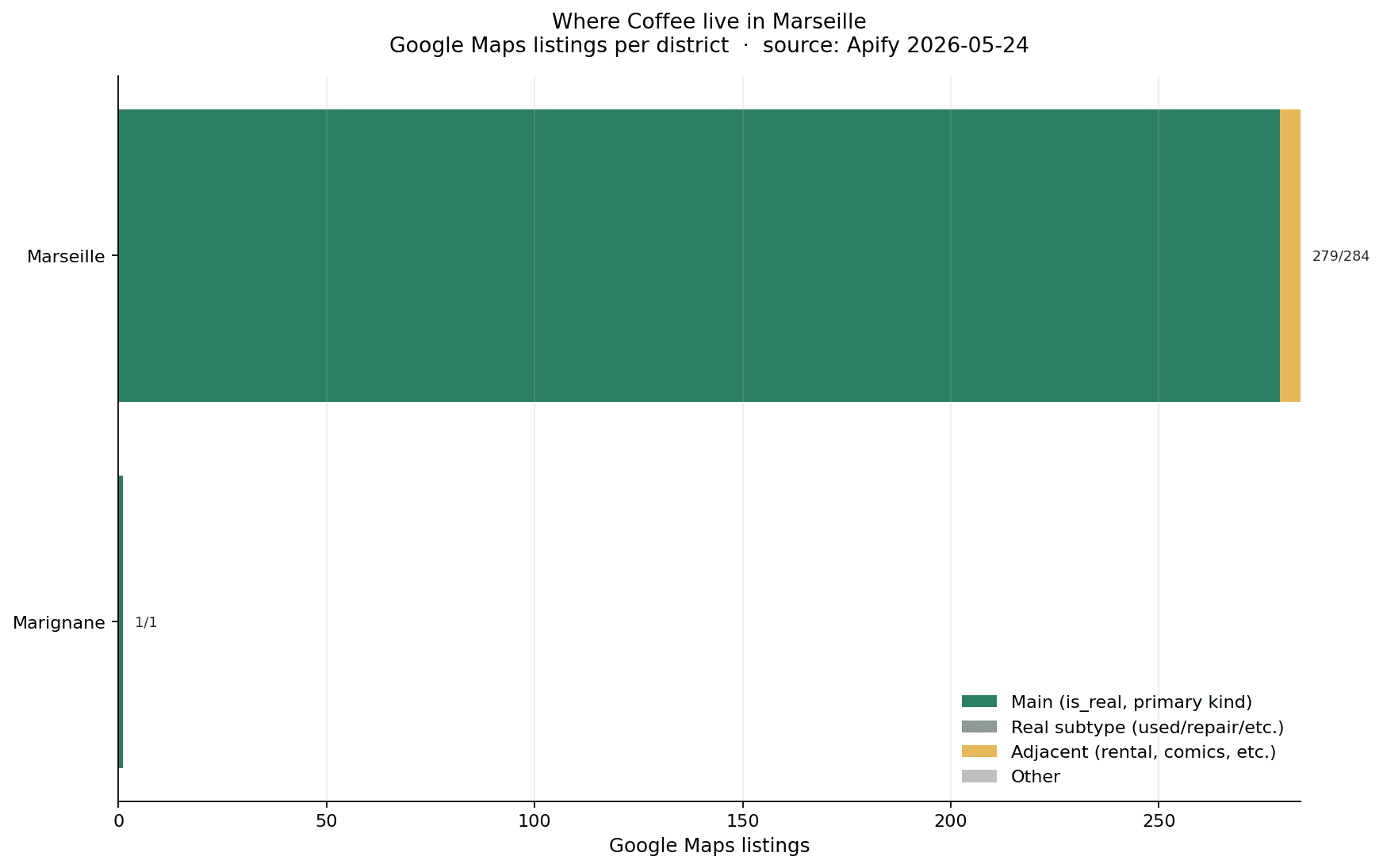
Where Marseille fits in the four-city picture
One row per city in the cross-vertical series, on the two axes that matter most for the entity-engine pattern: ChatGPT’s shop-website citation share, and the signature non-shop source the engine leans on instead.
| City + vertical | ChatGPT shop-site % | Signature non-shop source |
|---|---|---|
| Paris yoga | 32% | |
| Berlin yoga | 32% | Urban Sports Club |
| Amsterdam bikes | 42% | |
| Tokyo bookstores | 8% | whenin.tokyo + Tokyo Weekender |
| Marseille coffee | 10% | Reddit + Instagram + French local blogs |
What still generalises
- Per-engine personalities hold. Copilot is still the entity engine; Perplexity still the most diverse mix; Gemini still concentrates on one editorial vein; AI Mode still self-cites Google.
- Source mix bends to local infrastructure. Berlin (Urban Sports Club), Tokyo (local-guide web), Marseille (Reddit + Instagram + FR micro-guides) — same mechanism, different substrate.
- Language and proxy reshape the answer. EN/FR divergence widens further here, but the direction is the same as Paris and Berlin.
What Marseille adds
- The entity-engine baseline isn’t a law. The ~32% ChatGPT shop-site share we’d been treating as a constant is conditional on shops owning a digital footprint. When they don’t, it can drop to 10%.
- Instagram can be a primary AI citation source. Not just social proof — a top-3 cited domain on 3 of 5 engines.
- Gemini will substitute upward. No local specialty press → global trade press fills the slot. The shape of the source preference is fixed; the identity isn’t.
AI search behaviour — and an operational caveat
The plumbing notes for this dataset, including a reproducible capture-tool quirk that bit two of our studies in a row.
What this means for a Marseille café
The playbook isn’t “website or Instagram.” It’s show up where Marseille coffee is already documented.
- Your website still matters — for clean entity resolution, and for Copilot, which stays website-first. Just don’t expect it to carry the whole job.
- Your Instagram is an AI citation surface, not just a brand channel. With no booking transaction to host on a website, Instagram is where the scene documents itself — and the engines cite it.
- French micro-guides drive the French prompts. Getting into love-spots, marseillesecrete and the local-guide tail is worth more than another homepage tweak.
- English-language visibility is thin — so one good English page or write-up can overperform for tourist prompts.
- Don’t audit only one language. The EN and FR result sets overlap just 11% — check both.
A useful exception, not a new rule
The engines didn’t change personality. Copilot still prefers café websites, Perplexity still spreads across sources, Gemini still reaches for an editorial authority, and ChatGPT still blends recommendations with open-web citations. What changed is the local substrate.
In Marseille coffee the owned-web layer is thin — and there’s a clean reason why: there’s no transaction to host. Yoga and hotels sell bookings on their sites; a café sells nothing online, so its useful documentation lives elsewhere — Instagram, Reddit, French micro-guides and a few coffee-trade publications. So the engines go there.
The broader lesson: AI search doesn’t reward one universal content playbook. It reflects the shape of the local web. In Marseille, that shape is less “homepage + schema” and more “Instagram post + local blog + Reddit thread + enough English-language surface to be understood by tourists.”
So for hotels, restaurants, cafés or studios, the question isn’t “what does GEO say I should publish?” It’s: where does your category already get documented in your city? In Marseille coffee, the answer is clear — the AI-search ecosystem smells less like a sitemap and more like a terrasse.
Study design
Data collection
- 23 prompt templates × 2 languages (EN/FR) × 2 proxy countries (US/FR) × 5 AI engines = 460 theoretical; 413 captured (AI Mode × FR rejected, −46; one empty ChatGPT run, −1)
- Engines: ChatGPT, Perplexity, Gemini, Copilot, Google AI Mode
- Captured 2026-05-28
- 413 captures, 3,442 cited URLs, 786 distinct map entities
- 9 of 10 platform×proxy batches resolved — AI Mode × FR rejected
What we measured
- Shops named per answer (chain-aggregated leaderboard)
- Cited URLs bucketed into a 10-bucket source taxonomy
- EN vs FR top-5 overlap per prompt template
- .com vs .fr citation balance by prompt language (sample-limited)
- Per-platform social and review-aggregator share
- Cross-city comparison vs Paris yoga, Berlin yoga, Amsterdam bikes, Tokyo bookstores
How we turned answers into shops: the NER pipeline
AI answers are free text — “Deep is the obvious one, then maybe Black Bird up on Cours Julien, or Tarlata…” — not a clean list of businesses. To count anything, we first had to extract the shop mentions. Each answer (and each citation’s anchor text) ran through a named-entity-recognition (NER) pass that works in four steps:
- Span detection. A transformer NER model tags candidate spans — organisation/business names and the location phrases attached to them (quartier names, street addresses, “Vieux-Port,” “Cours Julien”). A coffee-specific gazetteer (“café,” “brûlerie,” “coffee,” “roasters”) boosts recall on names the base model would otherwise miss.
- Normalisation. Each candidate is lower-cased and stripped of boilerplate — the word “Marseille,” quartier suffixes, trademark glyphs and punctuation — so “Black Bird Coffee Marseille” and “Black Bird” collapse toward the same key.
- Entity resolution. Normalised mentions are matched to the 280-venue coffee registry — a 285-row Google Maps seed expanded with Google Places recovery (302 geocoded venues) and filtered to coffee-led spots. Fuzzy string similarity plus a domain match when the answer cited the shop’s own website. Ambiguous or sub-threshold spans are dropped. A frequently-recommended name that doesn’t match the seed is checked against Google Places: if it’s a real Marseille café the seed simply missed, it’s added and counted (this is how Black Bird Coffee and Ben Mouture entered the leaderboard); otherwise it’s flagged as a hallucination and excluded.
- Chain aggregation. Resolved entities that belong to the same brand are merged so a multi-location shop isn’t double-counted, while per-location coordinates are retained for the map.
A taxonomy pass also tightened the source bucketing: pre-pass, “other” held 54% of Marseille citations because the French local-blog tail was unfamiliar to the default classifier. Post-pass, “other” sits at 9% — the French micro-guide ecosystem bucketed cleanly into editorial_local.
Caveats
- AI Mode × FR proxy is missing. The capture tool rejected the batch at the trigger layer (HTTP-level, no snapshot ID). The same FR-proxy block hit Paris yoga; AI Mode × DE worked in Berlin. FR-specific to AI Mode, not a one-off.
- .fr TLD sample is too thin to read. Only ~22 of 280 Marseille coffee venues carry a .fr website; .fr citation counts sit below our trust threshold. The TLD section is rendered as a measurement limitation, not a finding.
- District-targeting null is a seed-granularity artifact. The Google Maps seed labels every shop city = “Marseille” with no quartier field; the 0% accuracy across all six quartiers is methodological, not behavioural. Same Amsterdam/Berlin pattern.
- NER resolution is high-precision by design: mentions the pipeline can’t confidently map to the registry are dropped, so counts are conservative lower bounds.
- Google AI Mode’s heavy reliance on google.com URLs may inflate its citation count relative to other engines.
- Disclosure: no personal affiliation with any Marseille specialty coffee shop.
Frequently Asked Questions
Summarize with AI


