Summary of takeaways
May 7, 2026 is the largest single-day step change in AI → hotel referrer traffic we’ve seen this year. Daily AI sessions across the Hotels Network panel jumped from a ~32,000/day baseline (May 1–6) to ~51,000/day (May 7–25) and held there.
AI’s share of all hotel-website sessions stepped from 0.64% → 0.92% between the pre- and post-May-7 windows. The denominator (total sessions) also grew, but the numerator grew faster — AI is taking share, not just riding tide.
Zoom out to the full 11-week window (Mar 16 → May 31) and AI is additive. Weekly AI sessions roughly doubled (+102%) while Direct grew ~14% and Organic ~7%. None of the core channels shrank — AI is net-new acquisition, not traffic cannibalised from Direct or Organic.
Reach is near-universal but shallow. 82% of active hotels now get some AI traffic — but for most it’s under 2% of sessions. The volume concentrates in the 1–5% “fat middle” (~30% of hotels, ~60% of all AI sessions), not in the handful of high-share darlings.
The mechanism: ChatGPT now embeds the hotel’s own website URL directly into the answer text, far more often than before May 7. Each one is a clickable, attributable referral with a real
chatgpt.comreferrer.This is a ChatGPT-only story — it owns 98.8% of AI referrals, up from 98.1%. The quiet sub-plot is the #2/#3 race: over 10 weeks Claude sessions rose +15% while Perplexity fell −15%. Claude is now at ~71% of Perplexity’s volume and, at this pace, could overtake it in 8–12 weeks. Both are a rounding error next to ChatGPT.
Hotels are not like SaaS. Where the AI sessions land barely moved — homepage share ~69% before and after. The May 7 change drove volume, not page-mix. Hotel websites were already homepage-heavy on AI traffic; the new volume just amplified that.
For hotels: AI mentions are no longer a perception metric. They’re a measurable direct-booking channel. The hotels that wire up the attribution now will see the next move before OpenAI announces it.
Hotelrank — the hotel AI-visibility product behind this research — has been acquired by Lighthouse (The Hotels Network), and I now work there. The panel data in this study comes from The Hotels Network. The analysis sticks to what the aggregated, anonymised data shows, but you should weigh that source relationship accordingly.
How we noticed it
We noticed it on a single hotel first. One anonymised 5-star luxury property in Paris — the same hotel that anchors our measurement framework article — sat at roughly 4–5% AI share of new GA4 users for three months. ChatGPT alone was 97% of that AI share. Boring, stable, slightly trending up.
On the morning of May 8 the daily referral count for chatgpt.com looked wrong. Not noisy-wrong — clean-doubling wrong. We assumed a tagging glitch, re-validated the GA4 channel group, then turned to the The Hotels Network referrer panel — more than 17,000 hotels, tracked against the same set of AI domains. Same pattern. May 7, broad-based across the panel, AI referrals stepped up and stayed up.
The surprising part wasn’t even the volume — it was what didn’t change. Landing-page mix barely moved. Other AI assistants barely moved. Total session volume on hotel sites moved a little (+13%), but AI’s slice of it jumped 44% in relative terms. ChatGPT alone reshaped the AI-traffic curve for hotels in a single day.
What changed on May 7
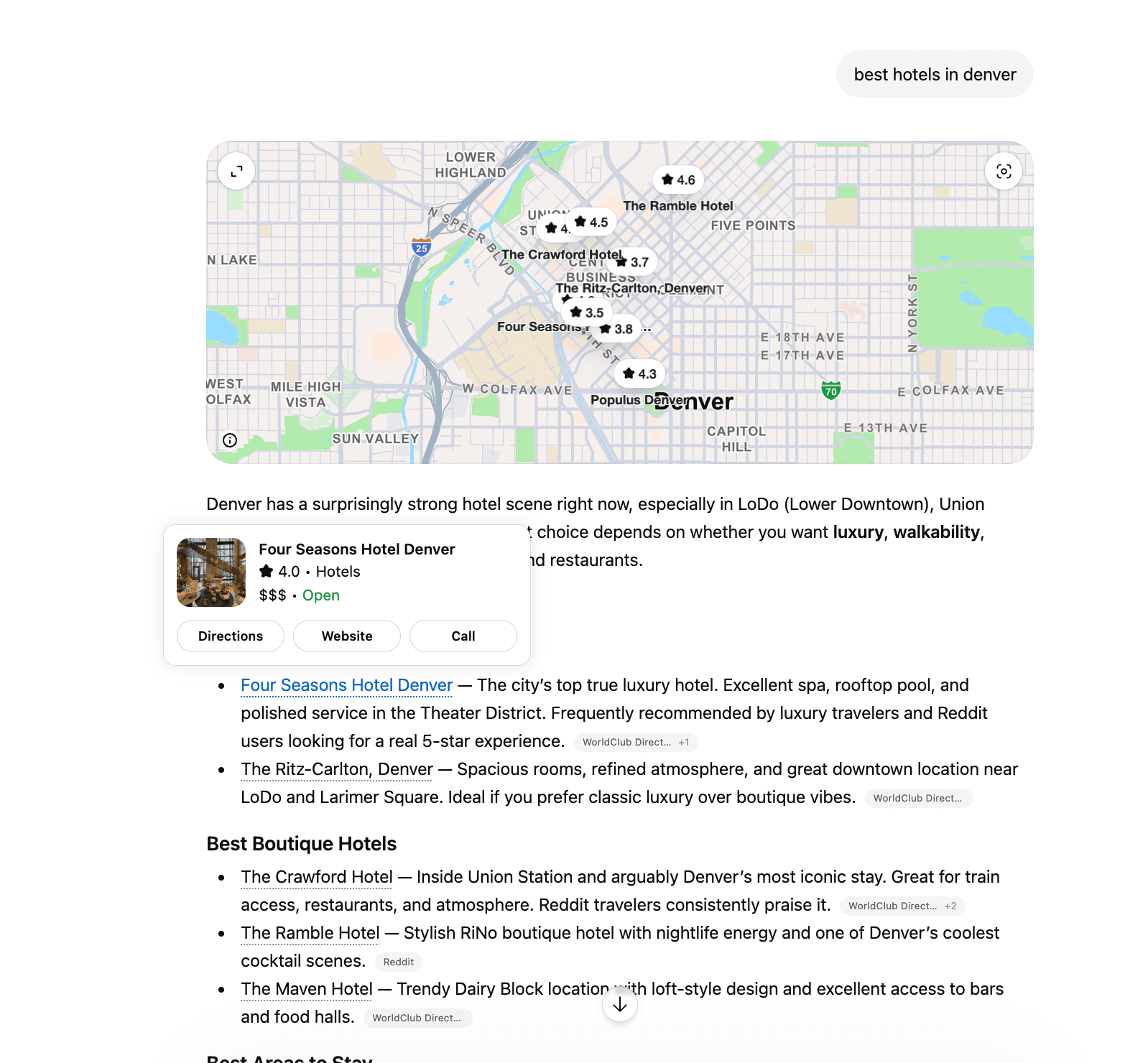
Before May 7, a typical ChatGPT hotel answer looked like this: a numbered list of hotel recommendations, each one a bolded property name followed by a short prose description. The only clickable elements were the citation chips in the right rail or at the end of the answer — pointing to Booking.com, Tripadvisor, a travel blog, or a Wikipedia entry. The hotel’s own website was almost never an inline link inside the answer.
After May 7, the same kind of question produces an answer where each recommended hotel name is itself a hyperlink — and the link points to the hotel’s own homepage, not to an OTA. The model is still recommending the same kind of hotels. It changed where the recommendation terminates. Brand names used to dead-end in a citation chip; now they route to the hotel’s front door.
1. Le Bristol Paris — iconic Avenue Matignon palace, three-Michelin-star dining, indoor garden pool.
2. Hotel Plaza Athenée — haute couture on Avenue Montaigne, Dior Institut spa.
3. The Ritz Paris — Place Vendôme, Hemingway Bar, recently renovated.
Citations in right rail: booking.com, tripadvisor.com, forbes.com.
1. Le Bristol Paris — iconic Avenue Matignon palace, three-Michelin-star dining, indoor garden pool.
2. Hotel Plaza Athenée — haute couture on Avenue Montaigne, Dior Institut spa.
3. The Ritz Paris — Place Vendôme, Hemingway Bar, recently renovated.
Each name now links to the hotel’s own homepage. Referrer: chatgpt.com.
The mechanism, in one sentence
ChatGPT didn’t change which hotels it recommends. It changed how those recommendations terminate. The brand name became the link. Hotels with mentions now also have traffic.
Zoom in — the step change is visible to the naked eye
Daily AI referrer sessions across the full Lighthouse / The Hotels Network panel, May 1 → May 25. May 1–6 sits in a tight band around 28–34K sessions/day. On May 7 the curve steps up to 43K and never returns to baseline — the post-window fluctuates between 43K and 59K, with a brief late-May dip and a recovery to 58K by May 25.
Source: Lighthouse / The Hotels Network panel daily AI referrer sessions, May 1–25, 2026. The step between May 6 (~34k) and May 7 (~43k) is the largest single-day jump in the panel’s 2026 history.
Why a sustained step change matters
A spike-and-fade pattern would suggest a one-off content moment, a viral recommendation, or an experiment OpenAI rolled back. Daily AI volume stays elevated — mostly 47–59K — for nearly three weeks through May 25, across weekends, midweek lulls, and a holiday in several markets. That’s the signature of a configuration change shipped to production, not a transient effect.
Zoom out — AI is additive, not redistributive
The daily chart shows the May 7 spike. The 11-week channel view shows what kind of traffic it is. The obvious worry with any new acquisition channel is cannibalisation — that AI is just rerouting visits that would have come through Direct or Organic anyway. The panel says otherwise. Between the weeks of March 16 and May 25, weekly AI sessions across the network roughly doubled — and every other core channel grew too. None shrank.
| Channel | Mar 16 / wk | May 25 / wk | Growth |
|---|---|---|---|
| AI | 178k | 360k | +102% |
| Direct | 10.6M | 12.1M | +14% |
| Organic search | 10.6M | 11.3M | +7% |
| Other | 13.3M | 16.4M | +24% |
| Total | 34.7M | 40.2M | +16% |
AI grew an order of magnitude faster than Direct or Organic over the same window, off a far smaller base. Source: Lighthouse / The Hotels Network panel weekly new sessions by channel.
Why “additive” is the word that matters
If AI were cannibalising Direct, you’d see Direct flatten or dip as AI climbed. Instead Direct grew +14% and Organic +7% right alongside AI’s +102%. AI is still tiny in absolute terms — 0.9% of all sessions — but it’s already 3.2% of organic-search-scale acquisition and climbing fast. For a channel that didn’t meaningfully exist a year ago, that’s the trajectory to watch, not the current size.
It’s a ChatGPT-only story
The panel tracks ten AI referrers. Strip ChatGPT out and the May 7 step change disappears entirely — none of the others moved on May 7. Mistral, Copilot, Gemini, and Grok sit in the statistical noise floor. But zoom into the #2 and #3 slots and there’s a quieter, opposite-direction race worth watching.
Same window, ChatGPT excluded. The May 7 inflection is the gap between the May 4 and May 11 weekly points — and it’s invisible here. None of the other AI assistants picked up similar traffic to hotels in this window.
ChatGPT’s dominance is settled. The contest for distant second is not — and the two are moving in opposite directions.
| Week | Perplexity | Claude | Claude / Perpl. |
|---|---|---|---|
| Mar 16 | 2,978 | 1,554 | 52.2% |
| Apr 13 | 2,460 | 1,565 | 63.6% |
| May 4 | 2,409 | 1,744 | 72.4% |
| May 18 | 2,536 | 1,790 | 70.6% |
Over 10 weeks Claude sessions rose +15% while Perplexity fell −15%. Claude also reaches about 76% of Perplexity’s hotel footprint — closer than the session ratio. At this pace Claude could pass Perplexity for the #2 AI-referrer slot in 8–12 weeks. Both remain ~1% of all AI traffic.
This panel measures referral traffic. Gemini doesn’t send any — not because nobody uses it.
Gemini’s near-zero weekly sessions across the entire 17,000-plus-hotel panel is not a usage signal. Gemini answers are served inside Google’s product surfaces — Search’s AI Overviews, the Gemini app, the AI Mode tab. When a user clicks through to a hotel from any of those, the referrer is google.com / google.* / no-referrer, indistinguishable from a normal organic Google click in GA4-style referrer panels.
By usage and reach, Gemini is one of the largest AI surfaces in 2026. Our Google AI Mode hotel study documents 4,000 hotel queries getting Gemini-shaped answers, and the live Landscape dashboard tracks Gemini citations at meaningful weekly volumes. None of that flows through a clean gemini.google.com referrer hostname — so a referrer-only panel reads as “0%.”
How to read this section honestly: “ChatGPT-only story” is true for directly attributable AI-driven referrals to hotel websites. It is not true for AI-driven hotel discovery overall. To see Gemini you need to measure prompt-level visibility (the Landscape dashboard) or server-log fetches (measurement framework, Method 1), not GA4 referrers.
A counter-intuitive consequence
When ChatGPT gained share by 0.7 percentage points in a market it already dominated at 98%, every other AI assistant with a distinct referrer hostname lost relative share — even while their absolute volumes were flat or slightly up. Among assistants that do route through their own branded referrer, the AI-traffic market for hotels is a ChatGPT monopoly — and getting more concentrated, not less.
More traffic, same destination
We expected the landing-page mix to shift on May 7. If ChatGPT had started embedding brand homepage URLs inline, the share of sessions landing on the homepage should have grown at the expense of deep pages. That’s the pattern other people have reported in non-hotel verticals.
For hotels, the page-type mix barely moved.
Share of AI referrer sessions across the Hotels Network panel, by landing-page type. Homepage share moved about a point — statistically indistinguishable from no change.
Hotels were already homepage-heavy
Roughly 69% of AI sessions to hotel websites landed on the homepage in the week before May 7 — and roughly 69% still do in the two weeks after. The May 7 change amplified the existing pattern, it didn’t reshape it. Hotel websites are built around a homepage that functions as the booking widget’s gateway, and AI assistants were already routing brand-name queries there before the inline-link change.
That makes the hotel category structurally different from SaaS or B2B destinations where May 7 caused a homepage unlock. For hotels, the story is simpler and arguably better: more traffic, same place. The landing page that’s already optimised for conversion just got 62% more cold-acquisition sessions a day.
Who actually gets the traffic
The panel average — AI at ~0.9% of new sessions — is the wrong number to fixate on. It hides two facts pulling in opposite directions. First, reach is near-universal: 82% of active hotels now get some AI traffic. A year ago that was near zero — this is network-wide adoption in a single quarter. Second, depth is shallow and skewed: for most of those hotels AI is still well under 2% of sessions.
Across the hotels with enough new-session volume to read a stable AI share (May 7–31), here’s how that share is spread — and, crucially, where the session volume actually sits (right-hand bars):
Left bar = % of hotels in the bucket. Right bar = % of all AI sessions the bucket generates. The 1–5% “fat middle” is ~30% of hotels but ~59% of the volume; the high-share outliers are a tiny fraction of hotels and of volume.
The volume lives in the middle, not the tail
The instinct is to chase the outliers — the small minority of hotels drawing 5%+ of new sessions from AI. They’re real, and for them AI is already a top acquisition channel. But together they’re only a few percent of all AI sessions. The traffic isn’t concentrated in a few AI-darling hotels.
It’s in the “fat middle”: the roughly 30% of hotels sitting at 1–5% AI share generate close to 60% of every AI session in the network. The takeaway for a typical hotel isn’t “become an outlier” — it’s “get from 0.5% to 2%,” which is where the realistic, compounding volume actually sits.
Source: Lighthouse / The Hotels Network panel, per-hotel AI share of new sessions, May 7–31, 2026. Restricted to hotels with enough weekly volume to read a stable share. Bucket edges are approximate.
What we don’t know yet
The panel data is by referrer host and landing page. It doesn’t segment by hotel category, star rating, chain affiliation, or geography — those cuts need a separate join against The Hotels Network’s hotel-attribute dimensions. We’ll publish that follow-up. In the meantime, a few hypotheses the cross-cut with our live AI Hotel Landscape dashboard makes worth testing:
- Hotels that ChatGPT names as brand recommendations (Le Bristol, Aman Tokyo, Singita) should capture more of the per-hotel lift than hotels that ChatGPT surfaces inside the clickable hotel shelf or via sponsored slots — those surfaces route clicks through OTA redirects, not to the hotel’s homepage.
- Independents probably gain more in percentage terms than chains, because ChatGPT often answers chain queries with the chain homepage rather than the specific property — diluting per-hotel uplift.
- Markets with strong brand-name recognition (Paris, NYC, London) likely see bigger absolute lifts than markets where ChatGPT defaults to descriptive recommendations (“a small palace near Place Vendôme”).
We’ll publish the segment cut in a follow-up once the visit-level and hotel-level data are linked up — that’s the one thing standing between this panel and a chain/star/geo breakdown.
Why might OpenAI have shipped this?
We don’t have inside knowledge of the product decision. But two threads are hard to ignore, and they’re not mutually exclusive.
Organic links become the training data the ads stack needs
The timing is striking. Our ChatGPT hotel ads study tracked OpenAI’s pivot from a $5M CPM-style sponsor model to a self-serve CPC ads manager with a $50K entry, around the same window. CPC ads need a click-through-rate signal to rank inventory. Embedding brand homepage URLs inline in organic answers, and watching which ones get clicked, is exactly the kind of training data that produces “which recommendations drive clicks in which contexts.”
Whether that’s the stated intent or a byproduct, the effect is the same — the organic recommendation surface now generates the CTR matrix that the paid hotel surface will eventually be ranked against. Hotels with strong organic AI mentions are training the ranker that will price their sponsored slots.
AI just stopped being a pure traffic sink for hotel websites
The dominant complaint from hoteliers, hotel publishers, and the broader travel-content ecosystem since ChatGPT launched has been the same: LLMs answer the question, the user never clicks through, and the hotel website gets a perception lift but no measurable traffic. That story made it harder for hoteliers to invest in content, harder for chains to justify the AI-visibility workstream, and easier for regulators to ask uncomfortable questions about what publishers and brands get back from being crawled.
The May 7 change doesn’t fix that on its own, and it doesn’t put ChatGPT anywhere near Google-scale referral volume to hotels. But it turns ChatGPT from a pure referral destination into a meaningful referral source. That matters for OpenAI’s relationships with publishers, brands, and regulators — and for the next time someone in a board meeting asks “are AI mentions worth anything.”
Methodology & caveats
The Hotels Network panel. Anonymised AI-referrer telemetry from The Hotels Network (part of Lighthouse) — an anonymised panel of more than 17,000 hotel websites, drawn from a wider Lighthouse / The Hotels Network customer base and covering March 16 – May 31, 2026 (11 weeks). All figures count new sessions only (repeat sessions within a visit are excluded) and are aggregated by week. The per-hotel AI-share distribution is restricted to the subset of hotels with enough weekly volume to read a stable share.
Channel definitions. Sessions are classified by referrer. AI = the major assistant hosts (ChatGPT, Perplexity, Claude, Copilot, Gemini, Grok, Mistral and others). Direct = no referrer. Organic search = the major search engines (Google, Bing, and similar). Other = everything else (paid, social, referrals). The May-7 daily step uses a pre-window of May 1–6 (6 days) and a post-window of May 7–25 (19 days).
Hotel A — single-property anchor. Anonymised 5-star luxury hotel in Paris from the existing measurement framework article, used here as the qualitative trigger that led us to check the wider panel. GA4 First user source dimension; the hotel runs a custom GA4 channel group bundling chatgpt.com, openai.com and historical variants into an “AI” segment.
What this study is not. It is not a measurement of bookings or revenue lift from ChatGPT. The referral surface is upstream of the booking funnel; mapping referrals to confirmed bookings requires the booking-engine thank-you event to be wired into the same channel group. Conversion analysis is deliberately excluded here while the booking-side date handling is being confirmed; we’ll publish revenue-side analysis once that’s resolved. Segment cuts (chain vs independent, star rating, geo) are also excluded while the link between the visit-level and hotel-level data is being finalised.
Caveats. The clean step-change rests on a 6-day pre-window, though the elevated level now holds across a full month of data into June. ChatGPT dominance in the AI-referrer mix (98%+) is partly a function of which AI assistants are widely deployed in May 2026 — Gemini in particular routes hotel traffic through Google’s existing referrer infrastructure and is undercounted in pure-referrer panels. Don’t read “ChatGPT > everyone else” as a verdict on AI quality — read it as a verdict on which AI assistants currently send their clicks through their own branded referrer.
Related research
How to measure AI hotel traffic and bookings
GA4 referrer setup, the channel group, the booking-event wire-up. The companion framework piece — this is where the attribution lives.
ChatGPT hotel ads are live — CPC pivot, ads manager, $50K entry
The CPC pivot that the inline-link change probably feeds. Same window, related cause.
The ChatGPT clickable hotel shelf
The dedicated hotel-card surface that bypasses the inline-link change. Where clicks route to OTAs, not to hotel homepages.
AI Hotel Landscape — ChatGPT tab
The weekly-refreshed dashboard. Watch which hotels ChatGPT names by brand each week — those are the hotels seeing the homepage lift.
Summarize with AI


