Two claims, only one is true
The whole AEO/GEO marketing layer rests on conflating two distinct claims:
Claim 1: Schema is useful in classical search
TrueRich results (prices, ratings, event times, FAQs) on Google SERPs. Knowledge Graph entity disambiguation. Voice assistants pulling structured fields. None of that goes away. If you’re responsible for technical SEO, keep implementing schema where it earns its keep.
Claim 2: Schema feeds the LLM
FalseSchema cannot reach into a transformer and improve its comprehension of your prose. The model isn’t architected to read schema as schema — it receives whatever text the search or retrieval layer fetched and chose to include, and processes that text as language tokens. The JSON-LD block on your hotel page doesn’t make the model “understand” you better. That part of the AEO pitch is just wrong.
But for hotels, schema still reaches the LLM — via a loop
For local / POI intent, the conclusion “schema doesn’t matter for AI search” is wrong. Look at where the major AIs actually source their hotel answers:
The grounding source the LLM calls is fed by schema (entity reconciliation into the KG, amenity markup, sameAs to Wikidata) and by the Knowledge Graph itself. So: schema doesn’t feed the LLM — but it feeds what the LLM calls. Same effect, different mechanism. Different mental model.
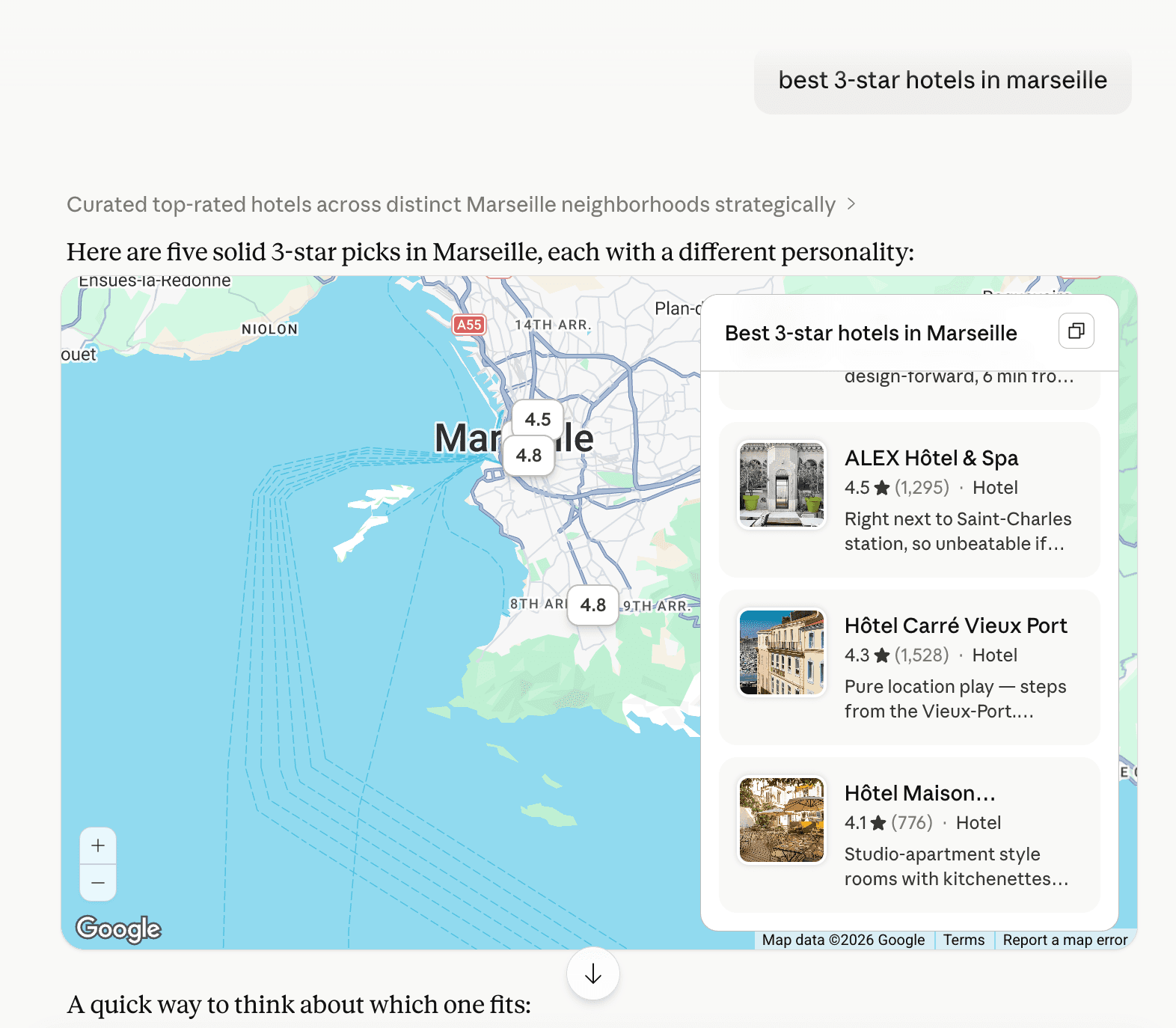
places_search call — star rating, photos, address, review count all sourced from Google Places, which in turn is fed by GBP and by the schema/sameAs signals that reconcile this hotel to its KG entity. The transformer never saw the JSON-LD on the hotel’s site. It saw the Places response.The careful version
Two refinements before you re-stamp every page with @type: Hotel:
GBP is the API surface — not the whole entity
Look at a Places API response in an LLM tool call and most of what you see — rating, review_count, hours, photos, address — comes from Google Business Profile. That’s what is visible to the model at call time, and it makes schema look redundant. But GBP is a narrow surface: no amenities field, no room categories, limited typed attributes. The fuller hotel entity sitting behind the Knowledge Graph has more on it — and that’s where your Hotel schema does work: amenity / starRating / category markup feeds KG enrichment that GBP can’t express, and sameAs reconciles your hotel to its OTA profiles (Booking, TripAdvisor, niche aggregators) so those profiles route grounding traffic to you, not to a near-duplicate listing. The clean way to say it: schema → entity graph → grounding source → LLM. Not the linear “schema → LLM” the AEO pitch implies — but also not the dismissive “GBP is all that matters” that the API view encourages.
Not the FAQ schema you think you need
Generic AEO advice for any business is “add FAQ schema, add HowTo schema, add Article schema.” For hotels that’s not where the leverage is. The four types that actually move the needle in the grounding loop are unsexy and specific:
@type: Hotel— notLocalBusiness, notOrganization. The category gate. KG entity reconciliation hinges on classifying you correctly in the first place.sameAs— an array of canonical URLs (Wikidata, your Booking listing, your TripAdvisor profile, your Google Maps URL). This is how your hotel page on your own site gets fused with the OTA profiles LLMs cite. Without it, aggregators get the grounding traffic; with it, you do.starRating— specifically the typedRatingobject withratingValue, not a number in your prose. AI hotel queries are sliced by category bucket (“best 4-star”, “luxury”, “budget”) and if your category is wrong or missing, you don’t appear in the relevant bucket — see the rankings consistency study on category gating.alternateName— the most underused field in hotel schema, and the one that solves a real and growing problem: hotels rebrand all the time. AIs trained on pre-rebrand data still recommend the old name. A specific case: Hôtel de la Paix in Beaune is now Alfred Hotel Beaune. WithalternateName: ["Hôtel de la Paix"]on the live page’s schema, the entity reconciliation can route the old query to the new identity. Without it, you’re fighting your own training data forever.sameAshandles cross-platform identity (you = your Booking listing);alternateNamehandles cross-time identity (you now = you then).
FAQ blocks may earn a rich result on a SERP, but they don’t change how a hotel surfaces in an AI answer. The boring four above do.
{
  "@context": "https://schema.org",
  "@type": "LocalBusiness",
  "name": "Hôtel Example",
  "description": "A wonderful hotel in Paris...",
  "address": { "@type": "PostalAddress", ... },
  "telephone": "+33...",
  "openingHours": "Mo-Su 00:00-24:00",
  "priceRange": "$$$",
  // FAQPage — fine if relevant, just not the main lever
  "mainEntity": [{
    "@type": "Question",
    "name": "Do you have free wifi?",
    "acceptedAnswer": { "@type": "Answer", ... }
  }]
  // no sameAs, no starRating, wrong @type
}{
"@context": "https://schema.org",
"@type": "Hotel",
"name": "Alfred Hotel Beaune",
"alternateName": ["Hôtel de la Paix"],
"address": {
"@type": "PostalAddress",
"streetAddress": "5 rue de l'Hôtel-Dieu",
"addressLocality": "Beaune",
"postalCode": "21200",
"addressCountry": "FR"
},
"starRating": {
"@type": "Rating",
"ratingValue": "4"
},
"sameAs": [
"https://www.wikidata.org/wiki/Q123456",
"https://www.booking.com/hotel/fr/example.html",
"https://www.tripadvisor.com/Hotel_Review-g187147-d000000.html",
"https://maps.google.com/?cid=00000000000000000000"
],
"amenityFeature": [
{ "@type": "LocationFeatureSpecification", "name": "Free WiFi", "value": true },
{ "@type": "LocationFeatureSpecification", "name": "Breakfast", "value": true }
]
}Amenities and HotelRoom — the part GBP can’t encode
Schema can encode a lot more than GBP exposes. You can ship typed amenities, room subtypes, bed configurations, accessibility flags, room sizes — and you control all of it directly from your CMS:
{
  "@type": "Hotel",
  "amenityFeature": [
    { "@type": "LocationFeatureSpecification", "name": "WiFi", "value": true },
    { "@type": "LocationFeatureSpecification", "name": "Pool", "value": true },
    { "@type": "LocationFeatureSpecification", "name": "Pet-friendly", "value": false }
  ],
  "containsPlace": [{
    "@type": "HotelRoom",
    "name": "Deluxe Suite",
    "bed": { "@type": "BedDetails", "numberOfBeds": 1, "typeOfBed": "King" },
    "occupancy": { "@type": "QuantitativeValue", "maxValue": 2 },
    "floorSize": { "@type": "QuantitativeValue", "value": 35, "unitCode": "MTK" },
    "amenityFeature": [
      { "@type": "LocationFeatureSpecification", "name": "Balcony", "value": true }
    ]
  }]
}
GBP gives you a narrow set of typed amenities (pool, parking, WiFi, breakfast) and no room-level structure at all — no bed types, no floor size, no accessibility per room. Your Hotel schema is the natural place to expose all of that. The markup is one-time, it’s entirely under your control, and it feeds the same entity graph the LLMs ground against. It’s the easiest delta over GBP to ship.
Two surfaces, two strategies
A hotelier’s own schema mostly affects how their own site surfaces — rich results, KG card, voice. What affects how they appear inside an LLM answer is whether the grounding sources (Maps/Places, OTAs, niche aggregators) carry them correctly. So the practical takeaway splits: keep schema on your site for classical SEO + KG hygiene; for AI visibility, also audit how you’re represented in the upstream sources LLMs actually call.
The actual finding
Don’t double down on AEO schema theatre. Don’t throw schema out either. For hotels (and for local intent generally), the right framing is: schema doesn’t feed the LLM, but it feeds what the LLM calls. The same playbook that earned you Knowledge Graph hygiene last decade earns you grounding-source hygiene this one. The optimisation game stays similar; only the target downstream of it has changed.
Frequently Asked Questions
Summarize with AI


